Swift from Zero to Expert #13: Protocols
A protocol is a contract, not a class. It says what a type must do without saying what it is — and that single idea powers delegation, synthesized Equatable, existentials, and the protocol extensions that make Swift idiomatic.
In the previous article we made our enums throwable by conforming them to one tiny protocol: Error. It had no methods, no properties — conforming to it was just a marker that said “a value of this type can be thrown.” That was your first protocol, and it hid the whole idea in plain sight. A protocol is a contract: it states what a type must be able to do, while staying completely silent about what that type is.
That separation is the point. Inheritance from #10 lets types share behavior only by sharing a superclass — a rigid, single-parent family tree that only classes can join. A protocol lets unrelated types — a struct, an enum, a class, even types you didn’t write — promise the same capability without sharing an ancestor. A Circle and a Country have nothing in common, yet both can promise “I have an area.” That promise is a protocol.
A class says “I am a kind of Animal.” A protocol says “I can do what a Drawable does.” One is about identity and ancestry; the other is about capability. Swift is built on the second idea.
Protocol syntax: defining the contract
You define a protocol much like a type, with the protocol keyword:
protocol SomeProtocol { // protocol definition goes here}A type states that it adopts a protocol by writing the protocol’s name after the type’s name, separated by a colon — exactly the syntax you’ve used for class inheritance. Multiple protocols are separated by commas, and if a class has a superclass, the superclass comes first:
struct SomeStructure: FirstProtocol, AnotherProtocol {    // structure definition goes here}
class SomeClass: SomeSuperclass, FirstProtocol, AnotherProtocol { // class definition goes here}Property requirements
A protocol can require a conforming type to provide a property with a particular name and type. Crucially, it does not say whether that property is stored or computed — only its name, its type, and whether it must be gettable, or gettable and settable.
Property requirements are always written with var. You write { get set } for a read-write requirement and { get } for a read-only one:
protocol SomeProtocol { var mustBeSettable: Int { get set } var doesNotNeedToBeSettable: Int { get }}The rule is about minimums. A { get set } requirement can’t be satisfied by a let or a read-only computed property — the conformer must offer both. A { get } requirement is satisfied by any property, and it’s fine for that property to also be settable if that’s useful to you.
Here’s a protocol with one instance-property requirement:
protocol FullyNamed { var fullName: String { get }}A struct can satisfy fullName with a plain stored property:
struct Person: FullyNamed { var fullName: String}let john = Person(fullName: "John Appleseed")// john.fullName is "John Appleseed"…and a class can satisfy the same requirement with a computed property from #9 — the protocol never knew or cared about the difference:
class Starship: FullyNamed { var prefix: String? var name: String init(name: String, prefix: String? = nil) { self.name = name self.prefix = prefix } var fullName: String { return (prefix != nil ? prefix! + " " : "") + name }}var ncc1701 = Starship(name: "Enterprise", prefix: "USS")// ncc1701.fullName is "USS Enterprise"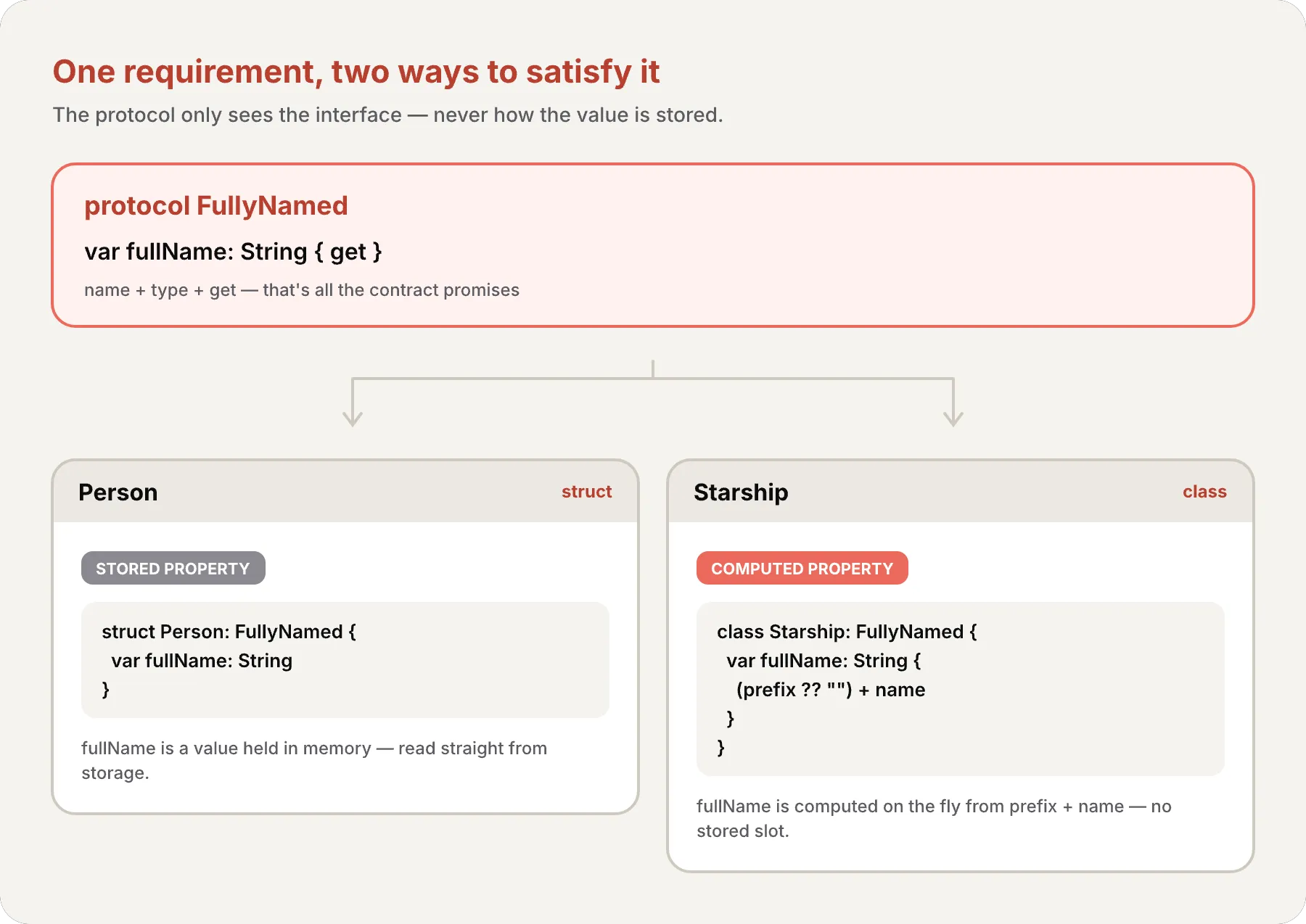
Method requirements
A protocol can require instance and type methods. You write them exactly like normal method declarations, but with no body and no braces — just the signature:
protocol RandomNumberGenerator { func random() -> Double}RandomNumberGenerator demands one method, random(), returning a Double. It says nothing about how the number is produced — that’s the conformer’s business. Here a class implements it as a linear congruential generator:
class LinearCongruentialGenerator: RandomNumberGenerator { var lastRandom = 42.0 let m = 139968.0 let a = 3877.0 let c = 29573.0 func random() -> Double { lastRandom = ((lastRandom * a + c) .truncatingRemainder(dividingBy: m)) return lastRandom / m }}As with properties, type-method requirements are prefixed with static in the protocol. Default parameter values aren’t allowed in a protocol’s method requirements — the contract states the signature, not convenience defaults.
Mutating method requirements
A method on a value type — a struct or enum from #8 — that needs to change self must be marked mutating. When a protocol requires such a method, it carries the mutating keyword into the contract, so that value types are allowed to satisfy it:
protocol Togglable { mutating func toggle()}An enum can now conform and flip its own state:
enum OnOffSwitch: Togglable { case off, on mutating func toggle() { switch self { case .off: self = .on case .on: self = .off } }}var lightSwitch = OnOffSwitch.offlightSwitch.toggle()// lightSwitch is now equal to .onInitializer requirements
A protocol can also require an initializer from #10 — again, just the signature, no body:
protocol SomeProtocol { init(someParameter: Int)}A class satisfying an initializer requirement must mark its implementation required. That word forces every subclass to also provide the initializer, so the entire class hierarchy keeps conforming:
class SomeClass: SomeProtocol { required init(someParameter: Int) { // initializer implementation goes here }}Protocols as types: the existential any
So far a protocol has been a checklist. But a protocol is also a type — you can use it where you’d use Int or String: as a variable’s type, a function parameter, an array’s element type. You met this already at the very end of #12, where Result { try f() } produced a Result<Int, any Error>, and we promised the any keyword would get its explanation here. This is it.
protocol Shape {    func draw() -> String}
struct VerticalShapes {    var shapes: [any Shape]    func draw() -> String {        return shapes.map { $0.draw() }.joined(separator: "\n\n")    }}
[any Shape] is an array whose elements can each be a different concrete type — a triangle here, a square there — as long as every one conforms to Shape. Because the box hides the concrete type, you may only touch what Shape itself promises: draw() is fine; a triangle’s size property is not, unless you cast back to the concrete type first.
![An [any Shape] array shown as a row of three boxes. Each box presents the same Shape interface lid with draw(), but wraps a different concrete type inside: Triangle, Square, and Circle. A callout notes the box is a runtime indirection that costs performance, which is why any is spelled out; generics and opaque some remove the box.](/_astro/any-shape-existential-boxes.CReJR86O_Z1uRBIu.webp)
Delegation: a protocol as a hand-off
One of the oldest and most useful protocol patterns is delegation — a type handing off part of its job to another object that promises, via a protocol, to handle it.
Here a dice game reports its progress to a delegate. The game holds an optional delegate and calls back at key moments:
class DiceGame {    let sides: Int    let generator = LinearCongruentialGenerator()    weak var delegate: Delegate?
    init(sides: Int) {        self.sides = sides    }
    func roll() -> Int {        return Int(generator.random() * Double(sides)) + 1    }
    func play(rounds: Int) {        delegate?.gameDidStart(self)        for round in 1...rounds {            let player1 = roll()            let player2 = roll()            if player1 == player2 {                delegate?.game(self, didEndRound: round, winner: nil)            } else if player1 > player2 {                delegate?.game(self, didEndRound: round, winner: 1)            } else {                delegate?.game(self, didEndRound: round, winner: 2)            }        }        delegate?.gameDidEnd(self)    }
    protocol Delegate: AnyObject {        func gameDidStart(_ game: DiceGame)        func game(_ game: DiceGame, didEndRound round: Int, winner: Int?)        func gameDidEnd(_ game: DiceGame)    }}
Two patterns from earlier chapters carry the whole design. delegate is Delegate?, so each call goes through optional chaining from #11 — delegate?.gameDidStart(self). If nobody is listening, the call simply no-ops. And the delegate is a weak reference to avoid a retain cycle, which is exactly why the protocol inherits AnyObject — making it class-only (more on that below).
Any class can become a tracker by conforming:
class DiceGameTracker: DiceGame.Delegate {    var playerScore1 = 0    var playerScore2 = 0    func gameDidStart(_ game: DiceGame) {        playerScore1 = 0        playerScore2 = 0    }    func game(_ game: DiceGame, didEndRound round: Int, winner: Int?) {        switch winner {        case 1: playerScore1 += 1        case 2: playerScore2 += 1        default: break        }    }    func gameDidEnd(_ game: DiceGame) {        if playerScore1 == playerScore2 {            print("The game ended in a draw.")        } else if playerScore1 > playerScore2 {            print("Player 1 won!")        } else {            print("Player 2 won!")        }    }}
let tracker = DiceGameTracker()let game = DiceGame(sides: 6)game.delegate = trackergame.play(rounds: 3)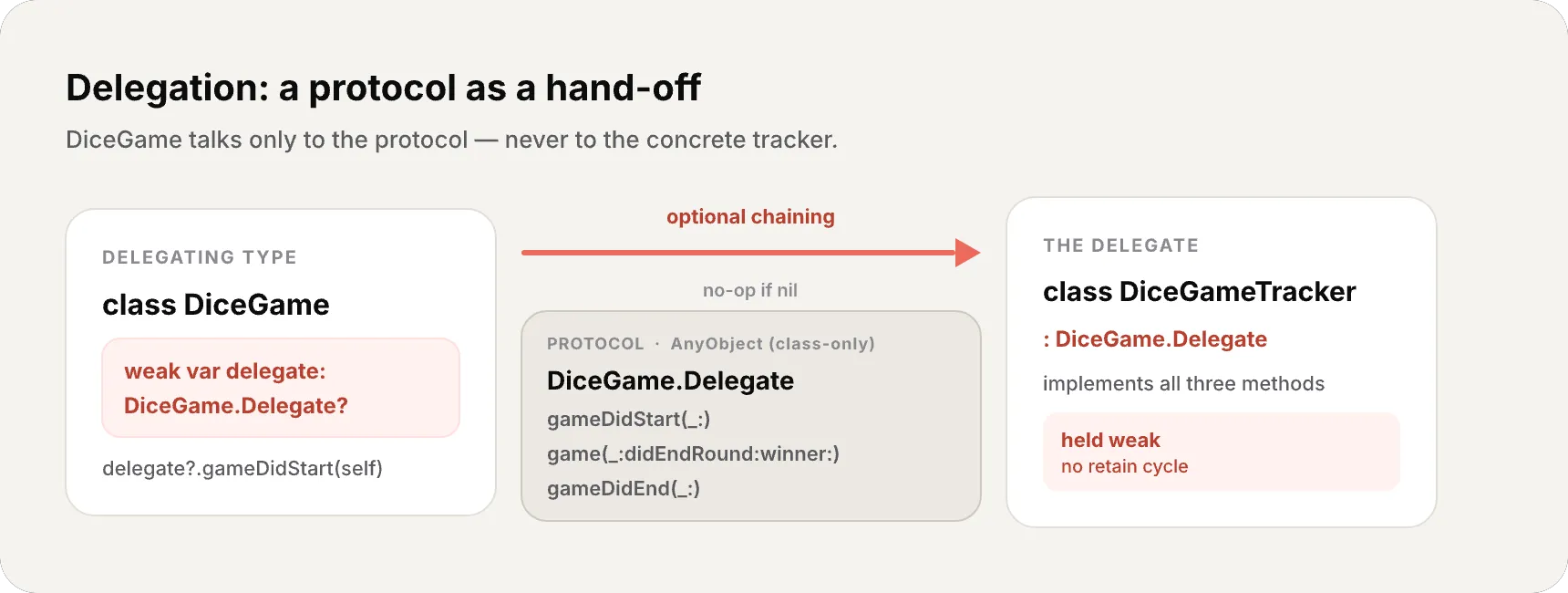
DiceGame never learns what kind of object tracker is. It only knows the contract — and that’s the whole power of delegation.
Adding conformance with an extension
You can make a type conform to a protocol in an extension, separately from its original declaration — even for a type whose source you don’t own. This is retroactive modeling: teaching Int, Array, or someone else’s type a new trick.
protocol TextRepresentable {    var textualDescription: String { get }}
extension Dice: TextRepresentable {    var textualDescription: String {        return "A \(sides)-sided dice"    }}
After this extension, every Dice — including ones created before the extension was written — is a TextRepresentable. The conformance applies to all existing and future instances.
Conditional conformance with where
A generic type can conform to a protocol only when its elements do. You express this with a where clause on the extension:
extension Array: TextRepresentable where Element: TextRepresentable { var textualDescription: String { let itemsAsText = self.map { $0.textualDescription } return "[" + itemsAsText.joined(separator: ", ") + "]" }}Here Element is the built-in generic name for whatever type the array holds — you’ll meet generics properly in #14. Now [Dice] is TextRepresentable (because Dice is), but [SomeRandomType] isn’t. The conformance is conditional on the element type.
Declaring adoption with an empty extension
If a type already meets every requirement but hasn’t said so, an empty extension makes the adoption official:
struct Hamster { var name: String var textualDescription: String { return "A hamster named \(name)" }}extension Hamster: TextRepresentable {}Synthesized conformance: Equatable, Hashable, Comparable
Some conformances are so mechanical that Swift writes them for you. For Equatable, Hashable, and Comparable, you often just declare the conformance and stop — the compiler synthesizes the implementation.
Declare Equatable on a struct whose stored properties are all Equatable, and == is generated for you (comparing every property), along with a free !=:
struct Vector3D: Equatable {    var x = 0.0, y = 0.0, z = 0.0}
let a = Vector3D(x: 2.0, y: 3.0, z: 4.0)let b = Vector3D(x: 2.0, y: 3.0, z: 4.0)if a == b {    print("These two vectors are equivalent.")}
Hashable is synthesized under the same conditions — structs whose stored properties are all Hashable, and enums whose associated values are all Hashable (or that have none). That’s what lets your own types become Set members and Dictionary keys, from #4.
Comparable is synthesized for enumerations without a raw value; if cases carry associated values, those must be Comparable too. Source order defines the ordering — earlier cases are “less than” later ones:
enum SkillLevel: Comparable { case beginner case intermediate case expert(stars: Int)}var levels = [SkillLevel.intermediate, SkillLevel.beginner, SkillLevel.expert(stars: 5), SkillLevel.expert(stars: 3)]for level in levels.sorted() { print(level)}// beginner// intermediate// expert(stars: 3)// expert(stars: 5)Defining < once buys you <=, >, and >= for free, because Comparable provides those on top of the one operator you (or the compiler) supply.
Collections of protocol types
Because a protocol is a type, you can store mixed concrete types in one array as long as they share a protocol. This is the existential array from earlier, put to work:
let things: [any TextRepresentable] = [game, d12, simonTheHamster]
for thing in things {    print(thing.textualDescription)}
Inside the loop, thing is statically any TextRepresentable — not DiceGame, Dice, or Hamster, even though that’s what each box really holds. You can call textualDescription because the protocol guarantees it; reaching for anything specific to the concrete type would require a cast.
Protocol inheritance
A protocol can inherit other protocols, adding requirements on top. The syntax mirrors class inheritance, but you can list several parents:
protocol PrettyTextRepresentable: TextRepresentable { var prettyTextualDescription: String { get }}Anything adopting PrettyTextRepresentable must satisfy both its own prettyTextualDescription requirement and the inherited textualDescription. The child can lean on the parent’s guarantee — a PrettyTextRepresentable implementation can call textualDescription, knowing it’s always there.
Class-only protocols with AnyObject
By default any kind of type can adopt a protocol. To restrict adoption to classes only, inherit from AnyObject:
protocol SomeClassOnlyProtocol: AnyObject, SomeInheritedProtocol { // class-only protocol definition goes here}A struct or enum that tries to adopt it is a compile-time error. This is the rule that made DiceGame.Delegate: AnyObject work: only reference types can be held weak, so a delegate protocol that wants a weak reference must be class-only.
Protocol composition with &
Sometimes one protocol isn’t a strong enough requirement — you need a value that conforms to several at once. Combine them with & into a protocol composition:
protocol Named { var name: String { get }}protocol Aged { var age: Int { get }}struct Person: Named, Aged { var name: String var age: Int}func wishHappyBirthday(to celebrator: Named & Aged) { print("Happy birthday, \(celebrator.name), you're \(celebrator.age)!")}let birthdayPerson = Person(name: "Malcolm", age: 21)wishHappyBirthday(to: birthdayPerson)// Happy birthday, Malcolm, you're 21!Named & Aged means “any type conforming to both.” It defines no new named protocol — it’s a temporary, on-the-spot combination. A composition may also include one class type, to require a particular superclass alongside the protocols:
func beginConcert(in location: Location & Named) { print("Hello, \(location.name)!")}Here location must be a subclass of Location and conform to Named — capability and ancestry, required together.
Checking conformance with is and as?
The is and as? operators — which we met catching errors by type — also test protocol conformance at runtime, with identical syntax:
isreturnstrueif the instance conforms to the protocol.as?returns an optional of the protocol type —nilif the instance doesn’t conform.as!force-casts and traps if the instance doesn’t conform.
protocol HasArea {    var area: Double { get }}
class Circle: HasArea {    let pi = 3.1415927    var radius: Double    var area: Double { return pi * radius * radius }    init(radius: Double) { self.radius = radius }}class Country: HasArea {    var area: Double    init(area: Double) { self.area = area }}class Animal {    var legs: Int    init(legs: Int) { self.legs = legs }}
let objects: [AnyObject] = [    Circle(radius: 2.0),    Country(area: 243_610),    Animal(legs: 4),]
for object in objects { if let objectWithArea = object as? HasArea { print("Area is \(objectWithArea.area)") } else { print("Something that doesn't have an area") }}// Area is 12.5663708// Area is 243610.0// Something that doesn't have an areaCircle, Country, and Animal share no base class — yet as? HasArea sorts the conformers from the rest at runtime. This is the same if let optional binding from #11, here unwrapping the result of a protocol cast. The objects aren’t changed; they’re just viewed through the narrow HasArea window for the duration of the binding.
Protocol extensions: default implementations
This is where protocols stop being mere checklists and become Swift’s defining feature. You can extend a protocol itself to provide method and property implementations — behavior that every conforming type gets for free, without writing anything.
extension RandomNumberGenerator { func randomBool() -> Bool { return random() > 0.5 }}Every RandomNumberGenerator now has randomBool(), built on the random() it already promised — and no conformer had to lift a finger:
let generator = LinearCongruentialGenerator()print(generator.random()) // 0.3746499199817101print(generator.randomBool()) // true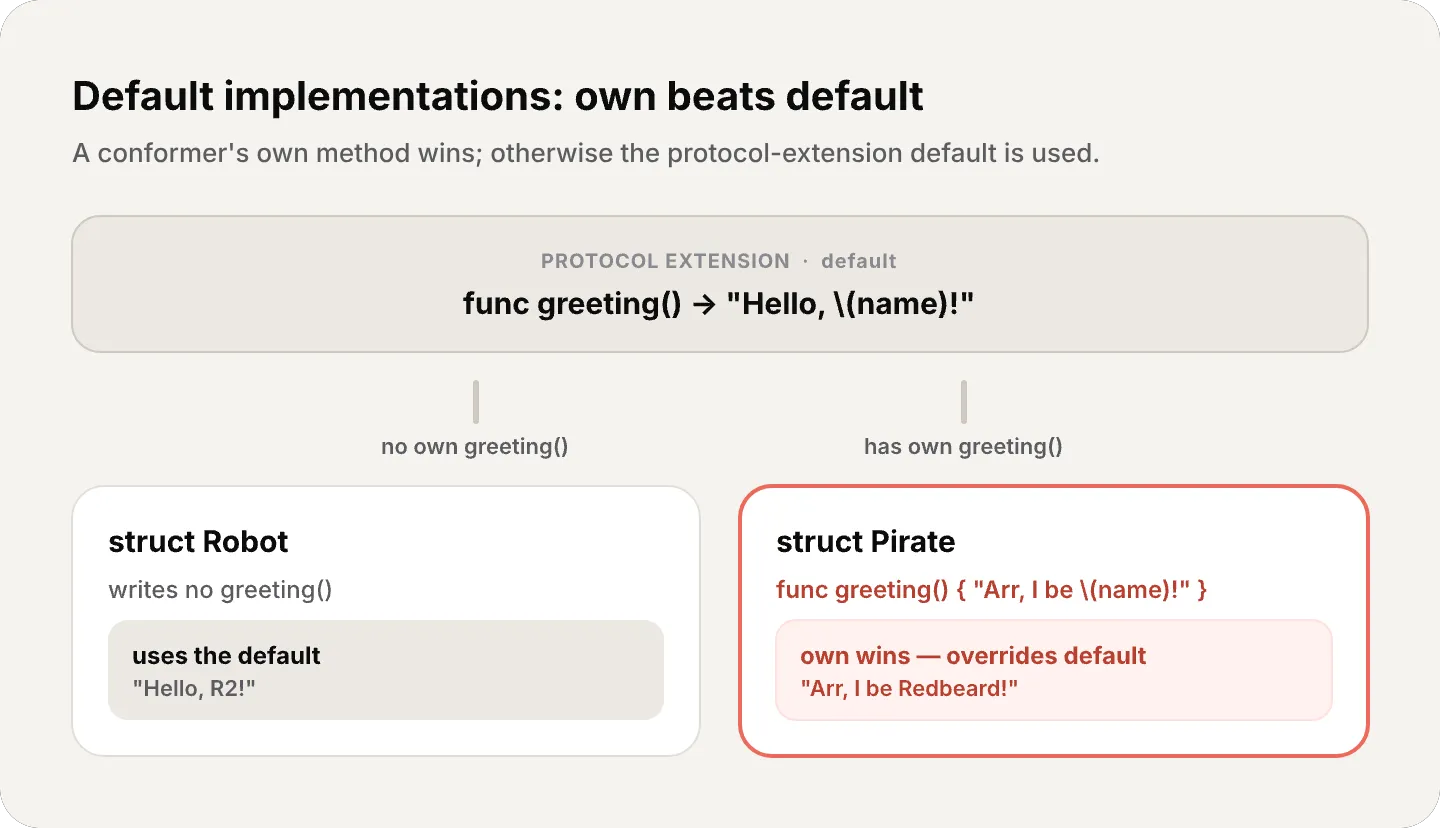
So a protocol can both declare a requirement and default it — letting conformers override only when they have something better to offer:
extension PrettyTextRepresentable { var prettyTextualDescription: String { return textualDescription }}This is the heart of protocol-oriented programming: shared behavior lives on the protocol, attached to a capability rather than a place in a class tree. Where inheritance from #10 forces shared code down a single line of descent, a protocol extension spreads it sideways to every conformer, related or not.
Inheritance shares code downward, through a class’s children. A protocol extension shares it outward, to every type that opts in — no superclass, no family tree, no permission needed. That sideways reach is why Swift is called protocol-oriented.
Constrained extensions with where
You can restrict a protocol extension so its members only appear when conforming types meet extra constraints — written, again, with a generic where clause:
extension Collection where Element: Equatable { func allEqual() -> Bool { for element in self { if element != self.first { return false } } return true }}allEqual() exists on any Collection from #4, but only when its Element is Equatable — because the body needs != to compare elements. Arrays of integers qualify:
let equalNumbers = [100, 100, 100, 100, 100]let differentNumbers = [100, 100, 200, 100, 200]
print(equalNumbers.allEqual())      // trueprint(differentNumbers.allEqual())  // false
This constrained-extension pattern is everywhere in the standard library — it’s how Array gets sorted() only when its elements are Comparable, and contains(_:) only when they’re Equatable. A capability that depends on another capability, expressed precisely.
Recap
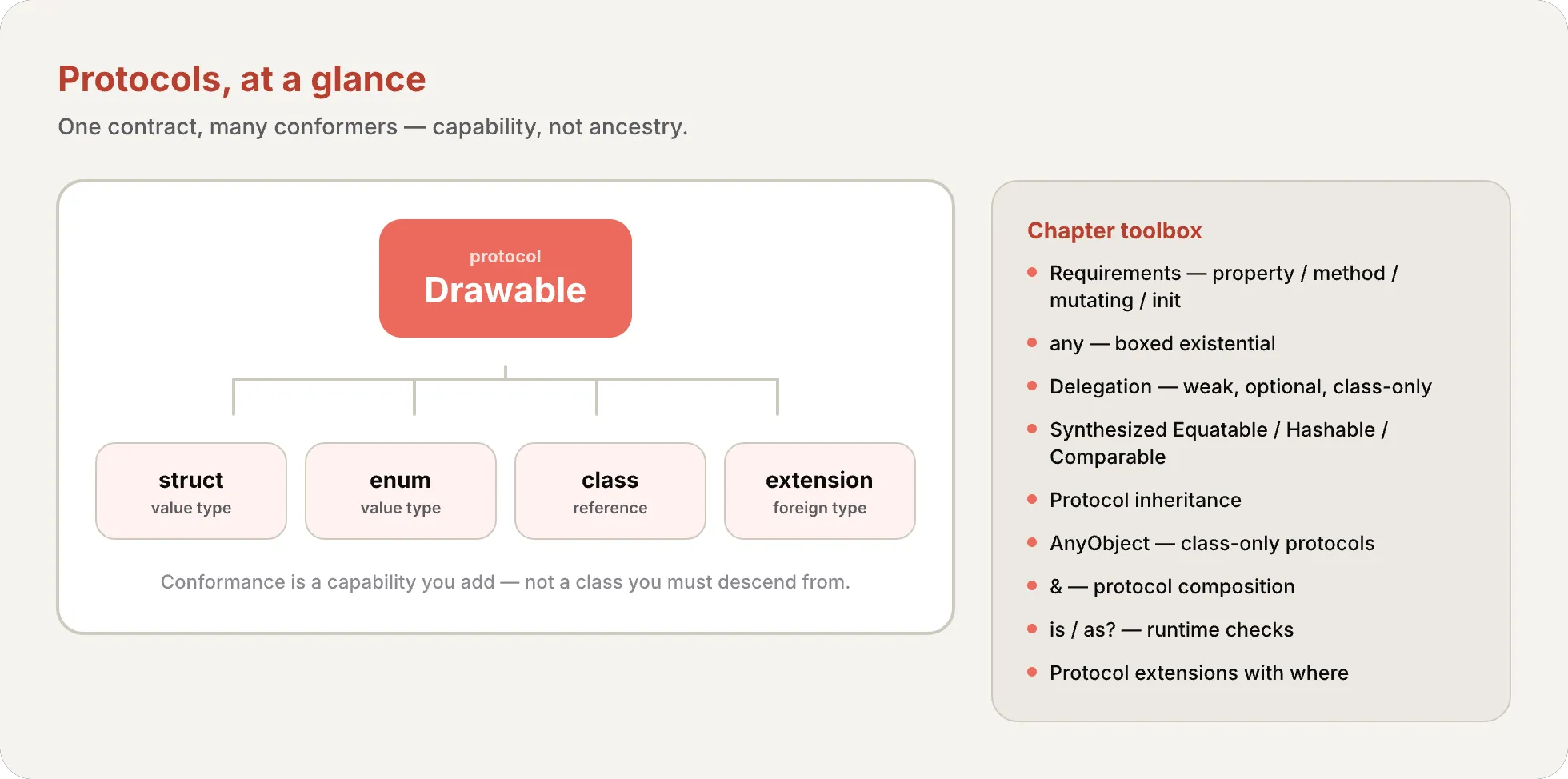
- Protocol — a contract of requirements (properties, methods, initializers) a conforming type must satisfy; about capability, not identity
- Requirements — properties (
{ get }/{ get set }), methods (signature only),mutatingmethods (to let value types in), andinit(classes mark itrequired) - Protocols as types —
any ProtocolNameis a boxed existential holding any conforming type at runtime, at the cost of a box - Delegation — a type hands off work to a
weak, optional, class-only delegate protocol, calling it through optional chaining - Conformance via extensions — add it retroactively, conditionally with
where, or declare it with an empty extension; conformance is always explicit - Synthesized conformance —
Equatable,Hashable, andComparableare auto-generated for simple structs and enums in the original file - Protocol inheritance — a protocol can inherit others and add requirements;
AnyObjectmakes a protocol class-only - Composition (
&) —A & Brequires conformance to several protocols (plus optionally one superclass) at once is/as?— check and cast protocol conformance at runtime, exactly like type casting- Protocol extensions — default implementations shared sideways to all conformers;
whereconstrains them to qualifying types — the backbone of protocol-oriented Swift
Challenges
Open a playground and try each one before opening the solution.
Challenge 1: Predict the toggle
A value type satisfies a mutating protocol requirement. What does this print?
protocol Togglable { mutating func toggle()}enum OnOffSwitch: Togglable { case off, on mutating func toggle() { switch self { case .off: self = .on case .on: self = .off } }}var lightSwitch = OnOffSwitch.offlightSwitch.toggle()lightSwitch.toggle()lightSwitch.toggle()print(lightSwitch)Show solution
onThe enum starts at .off. Each toggle() flips self, so the state walks off → on → off → on. Three toggles land on on. Because the protocol carries the mutating keyword, a value type like an enum is allowed to reassign self while still satisfying the contract.
Challenge 2: Fix the existential
This snippet won’t compile. Find the one mistake and fix it so the loop runs.
protocol Shape { func draw() -> String}struct Triangle: Shape { var size: Int func draw() -> String { return "Triangle" }}let shapes: [any Shape] = [Triangle(size: 3), Triangle(size: 7)]for shape in shapes { print(shape.size)}Show solution
for shape in shapes { print(shape.draw())}// Triangle// TriangleInside the loop shape is statically any Shape, not Triangle. The box hides the concrete type, so you may only touch what the Shape protocol promises — draw(). The size property belongs to Triangle, and reaching for it through the existential is a compile-time error (value of type 'any Shape' has no member 'size'). To use size you would have to cast back first with as?.
Challenge 3: Write a default implementation
Define a protocol Greeter with a single name: String { get } requirement and a protocol extension giving every conformer a greeting() -> String method that returns "Hello, <name>!". Then make a Robot that uses the default and a Pirate that overrides greeting() to return "Arr, I be <name>!".
Show solution
protocol Greeter { var name: String { get }}extension Greeter { func greeting() -> String { return "Hello, \(name)!" }}struct Robot: Greeter { var name: String}struct Pirate: Greeter { var name: String func greeting() -> String { return "Arr, I be \(name)!" }}print(Robot(name: "R2").greeting()) // Hello, R2!print(Pirate(name: "Redbeard").greeting()) // Arr, I be Redbeard!Robot writes no greeting() at all, yet gets one for free from the protocol extension’s default implementation, built on the name it promised. Pirate provides its own greeting(), and that wins over the default here because greeting() is called on the concrete Pirate type. Note the subtlety: greeting() lives only in a protocol extension, not as a Greeter requirement, so this override wins by static dispatch on the concrete type — call the same method through any Greeter and you’d get the extension’s default instead. To make the override win at every call site, declare greeting() -> String as an actual requirement of Greeter.
What’s next
We kept bumping into one wall: any Shape and [any TextRepresentable] box their values at a runtime cost, and a protocol with an associatedtype (which we deliberately skipped here) can’t even be used as any without limits. The answer is Generics — the next article — where the caller picks one concrete type, the compiler specializes the code, and the box disappears. We’ve been writing where Element: Equatable and Result<Success, Failure> all along; #14 finally explains the machinery. After that, #15 covers opaque types (some) — the third door alongside any and generics.
See you next week.
A protocol is the smallest possible promise: “a value of this type can do this.” From that one idea Swift builds delegation, equatability, existentials, and the protocol extensions that let behavior flow sideways across unrelated types. Inheritance asks what you are; a protocol asks only what you can do — and that question scales further.
References
Related
-
- swift
- swift-zero-expert
- swift-fundamentals
Swift from Zero to Expert #15: Opaque & Boxed Protocol Types
The third door out of 'I don't want to name the concrete type'. some hides one concrete type while keeping its identity — no box, compile-time. any erases the type into a runtime box. This is how you finally return a protocol that has an associatedtype.
-
- swift
- swift-zero-expert
- swift-fundamentals
Swift from Zero to Expert #14: Generics
One swapTwoValues, one Stack<Element>, one findIndex — written once, working for every type. Generics let the caller pick the concrete type, the compiler specialize the code, and the box from #13 disappear. Array, Dictionary, Optional, and Result were generic all along.
-
- swift
- swift-zero-expert
- swift-fundamentals
Swift from Zero to Expert #12: Error Handling
throw, try, do/catch, defer, rethrows, Result, and Swift 6 typed throws. An error isn't a magic exception — it's just a value of a type that conforms to Error, routed through your call stack as cheaply as a return.