
Swift from Zero to Expert #12: Error Handling
throw, try, do/catch, defer, rethrows, Result, and Swift 6 typed throws. An error isn't a magic exception — it's just a value of a type that conforms to Error, routed through your call stack as cheaply as a return.
In the previous article we drew a line: an optional is Swift’s way of saying “there might be no value here.” But absence isn’t always the whole story. When Int("hello") returns nil, you know it failed — but you don’t know why. For a string-to-int conversion, “it didn’t parse” is enough. For “open this file,” it isn’t: did the file not exist? Was it locked? Corrupt? Error handling is the half of the story optionals leave out — an expected failure, with a reason attached.
And just like an optional turned out to be just an enum, an error turns out to be just a value. There’s no special exception object, no magic runtime unwinding the stack. A Swift error is a value of a type that conforms to one empty protocol — and throw, try, and catch are the plumbing that routes that value from where it happened to where you handle it.
Swift errors aren’t exceptions. Throwing an error has the performance characteristics of a return, not a stack-unwinding catastrophe. An error is a value that travels up the call chain — nothing more exotic than that.
The Error protocol: errors are values
Because Error has no requirements, any type can be an error. But enumerations from #6 are the natural fit: a group of related failure conditions is exactly a set of cases, and associated values let each case carry extra detail about what went wrong.
enum VendingMachineError: Error { case invalidSelection case insufficientFunds(coinsNeeded: Int) case outOfStock}insufficientFunds doesn’t just say “not enough money” — it carries how many more coins are needed. That’s the whole point of an error over a bare nil: it answers why, not just whether.
To signal a failure, you throw one of these values:
throw VendingMachineError.insufficientFunds(coinsNeeded: 5)A throw statement transfers control immediately, exactly like return — except instead of handing a value back to the caller, it hands an error value up the chain until someone catches it.
throws: marking a function that can fail
func canThrowErrors() throws -> String
func cannotThrowErrors() -> String
The throws keyword is a contract, enforced by the compiler in both directions. Inside the function, you’re allowed to throw. Outside, every caller is forced to acknowledge that it might.
Here’s the canonical example from the Swift book — a vending machine whose vend method uses the early-exit guard from #5 to throw the right error the moment a precondition fails:
struct Item {    var price: Int    var count: Int}
class VendingMachine {    var inventory = [        "Candy Bar": Item(price: 12, count: 7),        "Chips": Item(price: 10, count: 4),        "Pretzels": Item(price: 7, count: 11),    ]    var coinsDeposited = 0
    func vend(itemNamed name: String) throws {        guard let item = inventory[name] else {            throw VendingMachineError.invalidSelection        }        guard item.count > 0 else {            throw VendingMachineError.outOfStock        }        guard item.price <= coinsDeposited else {            throw VendingMachineError.insufficientFunds(coinsNeeded: item.price - coinsDeposited)        }
        coinsDeposited -= item.price        var newItem = item        newItem.count -= 1        inventory[name] = newItem        print("Dispensing \(name)")    }}
Because a throw immediately transfers control, the item is vended only if every guard passes. The happy path stays flat and un-indented; the failures peel off at the top.
try: the visible cost of calling a thrower
You can’t call a throwing function silently. Every call to one must be marked with try — a keyword that makes the possibility of failure visible at the call site.
let favoriteSnacks = [    "Alice": "Chips",    "Bob": "Licorice",    "Eve": "Pretzels",]
func buyFavoriteSnack(person: String, vendingMachine: VendingMachine) throws {    let snackName = favoriteSnacks[person] ?? "Candy Bar"    try vendingMachine.vend(itemNamed: snackName)}
buyFavoriteSnack doesn’t handle the error — it has no do/catch. So it must itself be throws, and the error from vend flows straight through it to its caller. That’s propagation: an error rises through every try in its path until some scope decides to stop it.
Throwing initializers propagate the same way — useful when the init contract from #10 can’t be satisfied because a dependency failed:
struct PurchasedSnack { let name: String init(name: String, vendingMachine: VendingMachine) throws { try vendingMachine.vend(itemNamed: name) self.name = name }}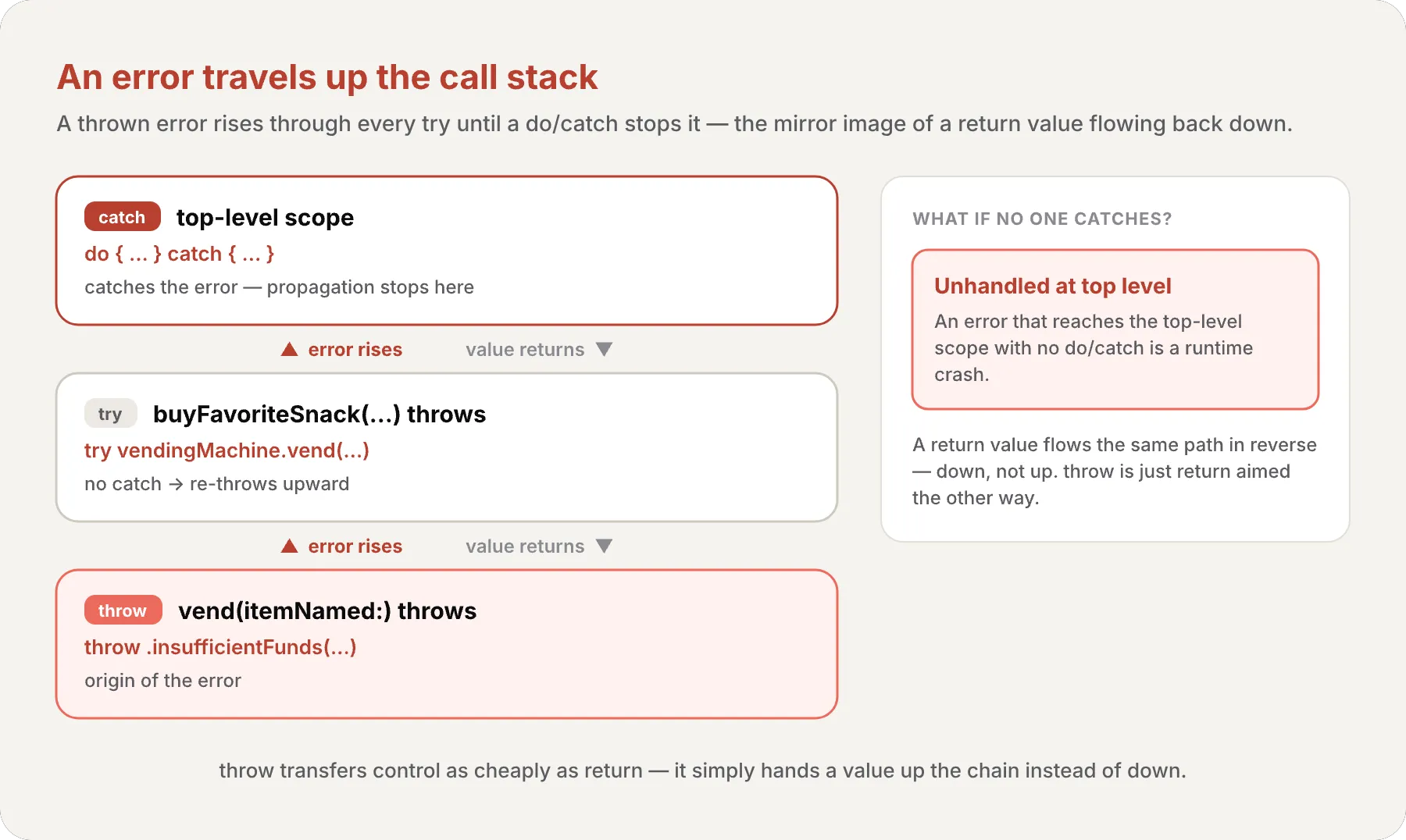
Every try is an admission: “the call I’m about to make might not finish normally.” Swift refuses to hide that from you — propagation is always spelled out, one try at a time.
do / catch: stopping the error
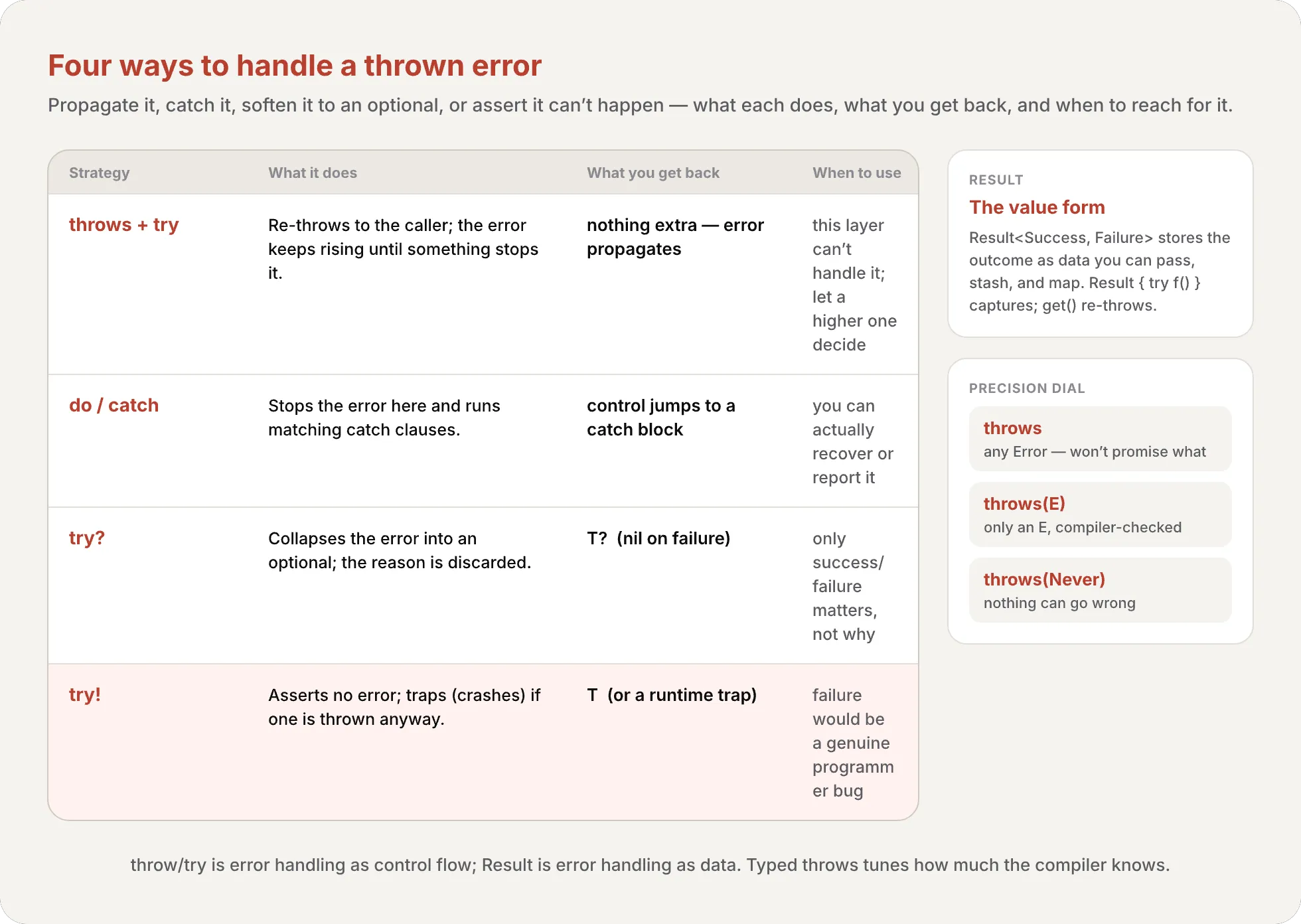
The four ways to handle a thrown error are: propagate it (we just saw that), turn it into an optional, assert it can’t happen, or — the workhorse — catch it with do/catch.
The general shape lets you match specific errors, add where conditions, group patterns with commas, and end with a catch-all:
var vendingMachine = VendingMachine()vendingMachine.coinsDeposited = 8do { try buyFavoriteSnack(person: "Alice", vendingMachine: vendingMachine) print("Success! Yum.")} catch VendingMachineError.invalidSelection { print("Invalid Selection.")} catch VendingMachineError.outOfStock { print("Out of Stock.")} catch VendingMachineError.insufficientFunds(let coinsNeeded) { print("Insufficient funds. Please insert an additional \(coinsNeeded) coins.")} catch { print("Unexpected error: \(error).")}// Insufficient funds. Please insert an additional 2 coins.Notice catch VendingMachineError.insufficientFunds(let coinsNeeded) — this is enum pattern matching from #6 again, binding the associated value right out of the caught error. And the final bare catch is special:
Partial handling and re-propagation
The catch clauses don’t have to handle every possible error. If none of them match, the error keeps propagating to the surrounding scope — which then bears the same responsibility. You can catch by type with the is pattern, handling a whole family at once and letting everything else pass through:
func nourish(with item: String) throws {    do {        try vendingMachine.vend(itemNamed: item)    } catch is VendingMachineError {        print("Couldn't buy that from the vending machine.")    }}
do {    try nourish(with: "Beet-Flavored Chips")} catch {    print("Unexpected non-vending-machine-related error: \(error)")}// Couldn't buy that from the vending machine.
Or list several related errors after a single catch, separated by commas:
func eat(item: String) throws { do { try vendingMachine.vend(itemNamed: item) } catch VendingMachineError.invalidSelection, VendingMachineError.insufficientFunds, VendingMachineError.outOfStock { print("Invalid selection, out of stock, or not enough money.") }}try? and try!: collapsing an error into an optional (or a crash)
Sometimes you don’t want a do/catch ceremony. Two variants of try shrink the whole thing to a single keyword — and this is exactly the bridge back to last chapter’s optionals we promised.
func someThrowingFunction() throws -> Int {    // ...}
let x = try? someThrowingFunction()
// x behaves exactly like y below:let y: Int?do {    y = try someThrowingFunction()} catch {    y = nil}
This is try?’s entire personality: it throws away the why and keeps only the whether, turning an error back into the nil we started the last chapter with. It shines when you want to try several approaches and fall back, leaning on the if-let binding from #11:
func fetchData() -> Data? { if let data = try? fetchDataFromDisk() { return data } if let data = try? fetchDataFromServer() { return data } return nil}The reckless sibling is try!:
let photo = try! loadImage(atPath: "./Resources/John Appleseed.jpg")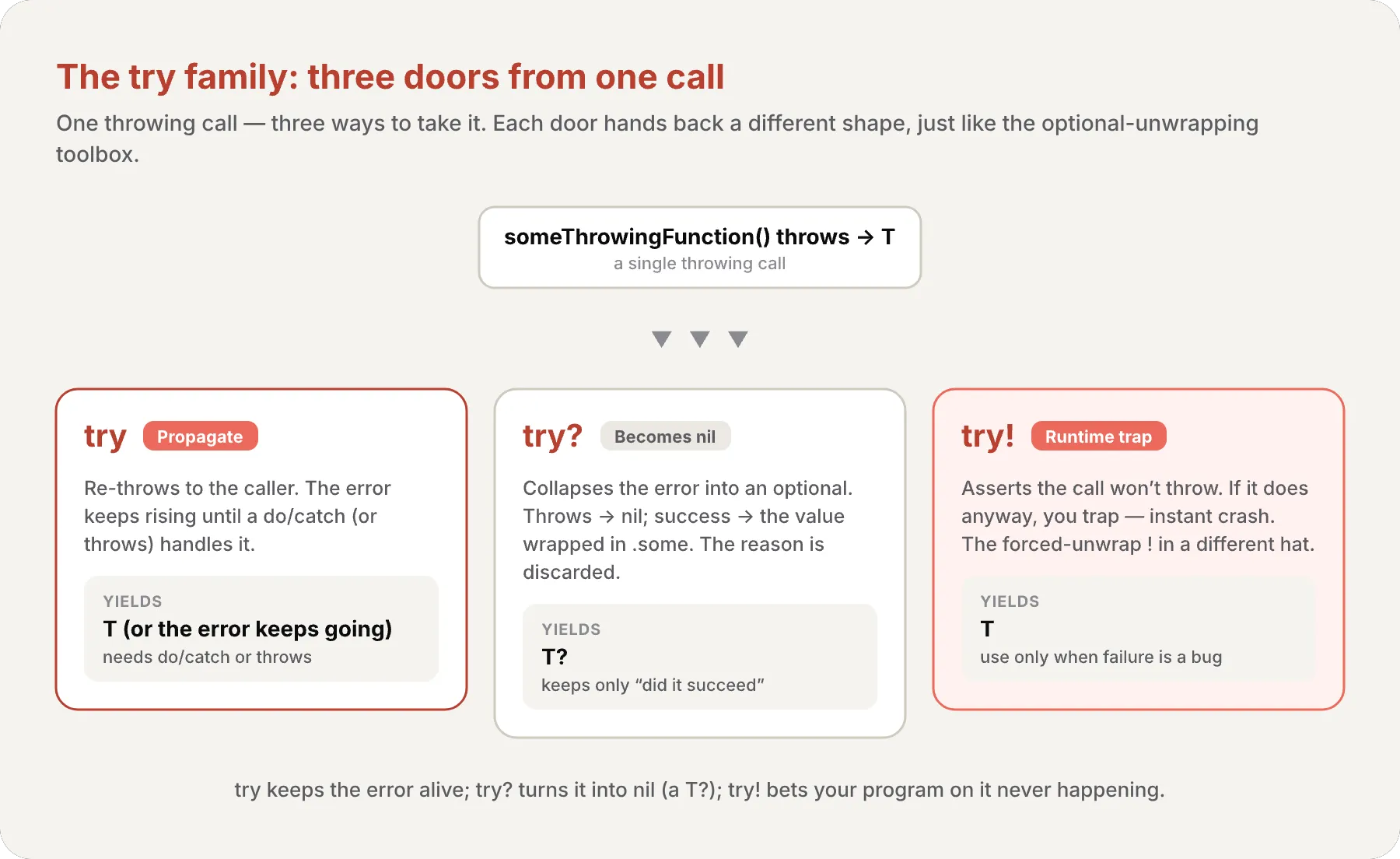
defer: cleanup that always runs
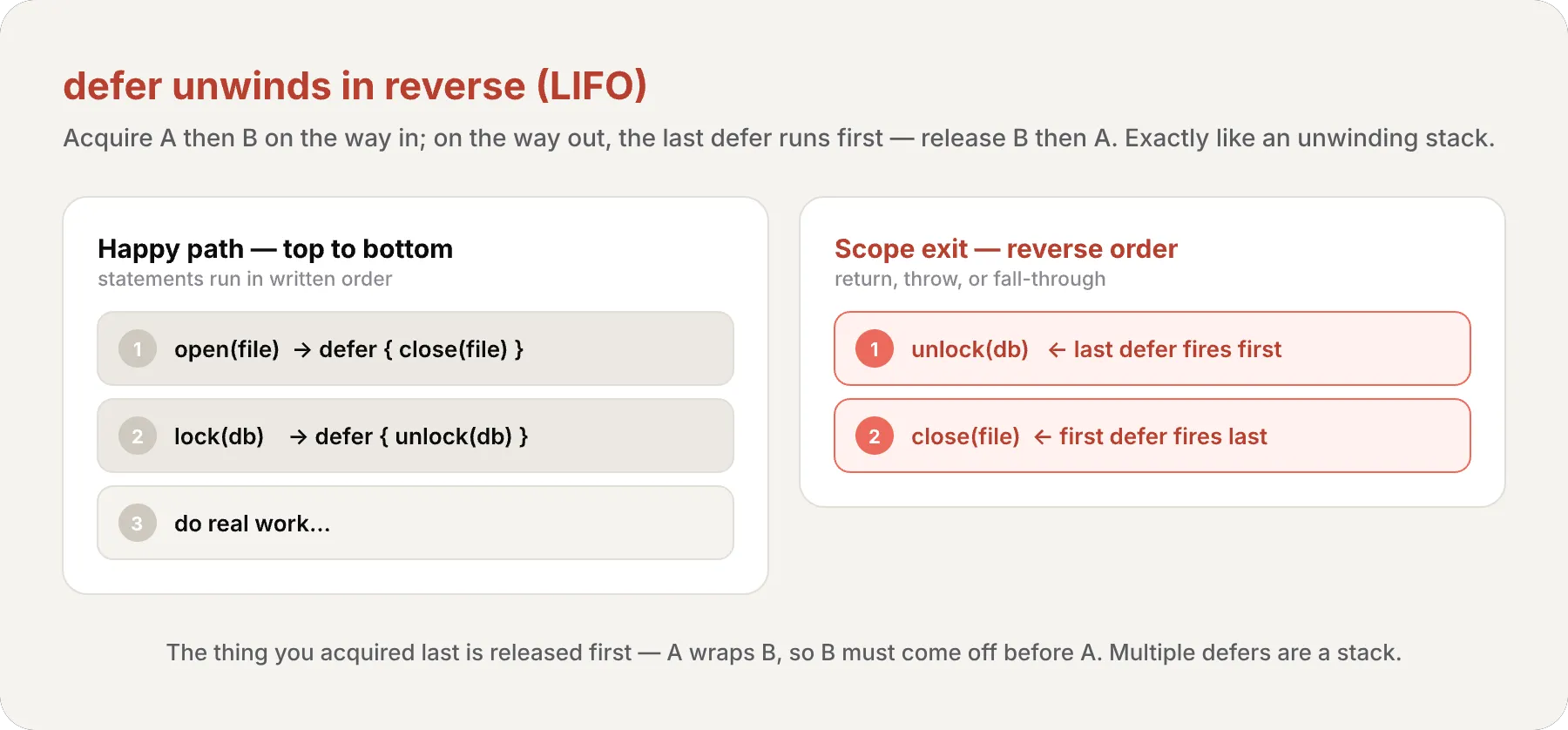
You open a file, you must close it. You acquire a lock, you must release it. The problem: between acquire and release, anything might throw — and an early exit would skip your cleanup. defer solves this.
func processFile(filename: String) throws { if exists(filename) { let file = open(filename) defer { close(file) } while let line = try file.readline() { // Work with the file. } // close(file) runs here, at the end of the scope — // and just as reliably if file.readline() throws. }}The try file.readline() might throw mid-loop. Without defer, the close(file) after the loop would be skipped on that path. With it, close(file) is guaranteed to run on the way out — error or no error.
rethrows: throwing only if your closure does
Consider a function that takes a closure and calls it — like map. Should it be throws? Only if the closure you hand it throws. If you pass a non-throwing closure, the function can’t possibly fail, and forcing a try on every call would be noise. rethrows expresses exactly this conditional contract.
func transform(_ value: Int, using f: (Int) throws -> Int) rethrows -> Int {    try f(value)}
// non-throwing closure -> no try needed:let doubled = transform(21) { $0 * 2 }
// throwing closure -> try required:let parsed = try transform(21) { try riskyTransform($0) }
This is why standard-library higher-order functions on collections — map, filter, reduce, the ones we met with closures in #7 — are rethrows. They stay invisible when your closure is pure, and become throwing the moment you hand them work that can fail.
Result: an error you can hold and pass around
throw/try/catch route an error through control flow — it happens, it propagates, you catch it, it’s gone. But sometimes you need to store the outcome of a fallible operation as an ordinary value: to hand it to a completion callback, stash it, compare it, or transform it later. That’s Result.
Stripped down, it’s an enum you could almost have written yourself:
enum Result<Success, Failure> where Failure: Error { case success(Success) case failure(Failure)}You consume it with the same switch pattern matching from #6:
func loadConfig() -> Result<Config, ConfigError> { /* ... */ }
switch loadConfig() {case .success(let config):    print("Loaded \(config).")case .failure(let error):    print("Failed: \(error).")}
The bridge between the two worlds — thrown errors and stored results — is built right into the type. The init(catching:) initializer runs a throwing closure and captures the outcome into a Result; get() does the reverse, re-throwing the stored error if there is one:
// throwing world -> value world:let result = Result { try someThrowingFunction() }// result is Result<Int, any Error>
// value world -> throwing world:do {    let value = try result.get()   // returns the success, or re-throws the failure    print(value)} catch {    print("Got error: \(error)")}
Here any Error means “some value whose concrete type conforms to Error, decided at runtime” — the any keyword signals type erasure; we’ll meet it properly with protocols in #13.
Typed throws: naming the error
Everything so far type-erases the error. A plain throws function can throw any Error — at a catch, all you statically know is “some error,” which is why you reach for a catch-all. Most of the time that’s the right default: new library versions throw new errors, and you don’t want to know every one ahead of time.
But occasionally you can enumerate every failure — a small library, an embedded system, a closure that only forwards a known error — and you’d like the compiler to hold you to it. Typed throws (Swift 6) lets you name the exact error type.
enum StatisticsError: Error {    case noRatings    case invalidRating(Int)}
func summarize(_ ratings: [Int]) throws(StatisticsError) {    guard !ratings.isEmpty else { throw .noRatings }
    var counts = [1: 0, 2: 0, 3: 0]    for rating in ratings {        guard rating > 0 && rating <= 3 else { throw .invalidRating(rating) }        counts[rating]! += 1    }    print("*", counts[1]!, "-- **", counts[2]!, "-- ***", counts[3]!)}
Two payoffs are visible already. First, because the error type is fixed, you can write the shorthand throw .noRatings instead of throw StatisticsError.noRatings — Swift infers the type. Second, if you tried to throw VendingMachineError.outOfStock from inside summarize, it would fail at compile time: that’s not the declared error type.
A typed-throws function slots cleanly into the untyped world — StatisticsError is a valid any Error:
func someThrowingFunction() throws { // i.e. throws(any Error) let ratings = [1, 2, 3, 2, 2, 1] try summarize(ratings)}You can type a do-catch too. The reward is an exhaustive, type-safe catch — the caught error is a concrete StatisticsError, so you can switch over it with no catch-all:
let ratings: [Int] = []do throws(StatisticsError) { try summarize(ratings)} catch { switch error { // error is a StatisticsError, not any Error case .noRatings: print("No ratings available") case .invalidRating(let rating): print("Invalid rating: \(rating)") }}// No ratings availablePlain throws says “something might go wrong — I won’t promise what.” throws(E) says “only an E can go wrong, and the compiler will hold me to it.” throws(Never) says “nothing can.” Three precise points on one dial.
Recap
- Error protocol — errors are values of types conforming to the empty
Errorprotocol; enums with associated values are the natural fit - throw — transfers control immediately, like
return, but hands an error up the chain; as cheap as a return, not an exception - throws — marks a function that can fail; only throwing functions propagate, and callers must acknowledge with
try - try / try? / try! —
trypropagates;try?converts the error tonil(aT?);try!asserts no error and traps if wrong - do / catch — stops a thrown error; bare
catchbindserror; clauses can match by pattern, byistype, or by comma-separated lists; an unhandled error at top level crashes - defer — cleanup that runs on every exit path; multiple defers run in reverse order
- rethrows — throws only if a closure argument throws; how
map/filter/reducestay non-throwing for pure closures - Result<Success, Failure> — error handling as a stored value;
Result { try f() }captures,get()re-throws - Typed throws —
throws(E)names the exact error type for compile-time exhaustiveness; plainthrowsisthrows(any Error);throws(Never)can’t throw
What’s next
In the next article we explore Protocols — the contracts that let unrelated types share an interface without sharing a superclass. We’ve leaned on one already: Error is a protocol, and conforming to it is what made our enums throwable. Next we’ll see how protocols define requirements, how types adopt them, and why protocol-oriented design is the backbone of idiomatic Swift.
See you next week.
An optional answered “is there a value?” An error answers “and if not, why not?” Together they cover the two honest failure modes of any operation — and neither one is magic. One is an enum with two cases; the other is a value routed up your call stack. Once you see that, error handling stops being scary and starts being just another shape your data can take.
References
Related
-
- swift
- swift-zero-expert
- swift-fundamentals
Swift from Zero to Expert #15: Opaque & Boxed Protocol Types
The third door out of 'I don't want to name the concrete type'. some hides one concrete type while keeping its identity — no box, compile-time. any erases the type into a runtime box. This is how you finally return a protocol that has an associatedtype.
-
- swift
- swift-zero-expert
- swift-fundamentals
Swift from Zero to Expert #14: Generics
One swapTwoValues, one Stack<Element>, one findIndex — written once, working for every type. Generics let the caller pick the concrete type, the compiler specialize the code, and the box from #13 disappear. Array, Dictionary, Optional, and Result were generic all along.
-
- swift
- swift-zero-expert
- swift-fundamentals
Swift from Zero to Expert #13: Protocols
A protocol is a contract, not a class. It says what a type must do without saying what it is — and that single idea powers delegation, synthesized Equatable, existentials, and the protocol extensions that make Swift idiomatic.