Swift from Zero to Expert #15: Opaque & Boxed Protocol Types
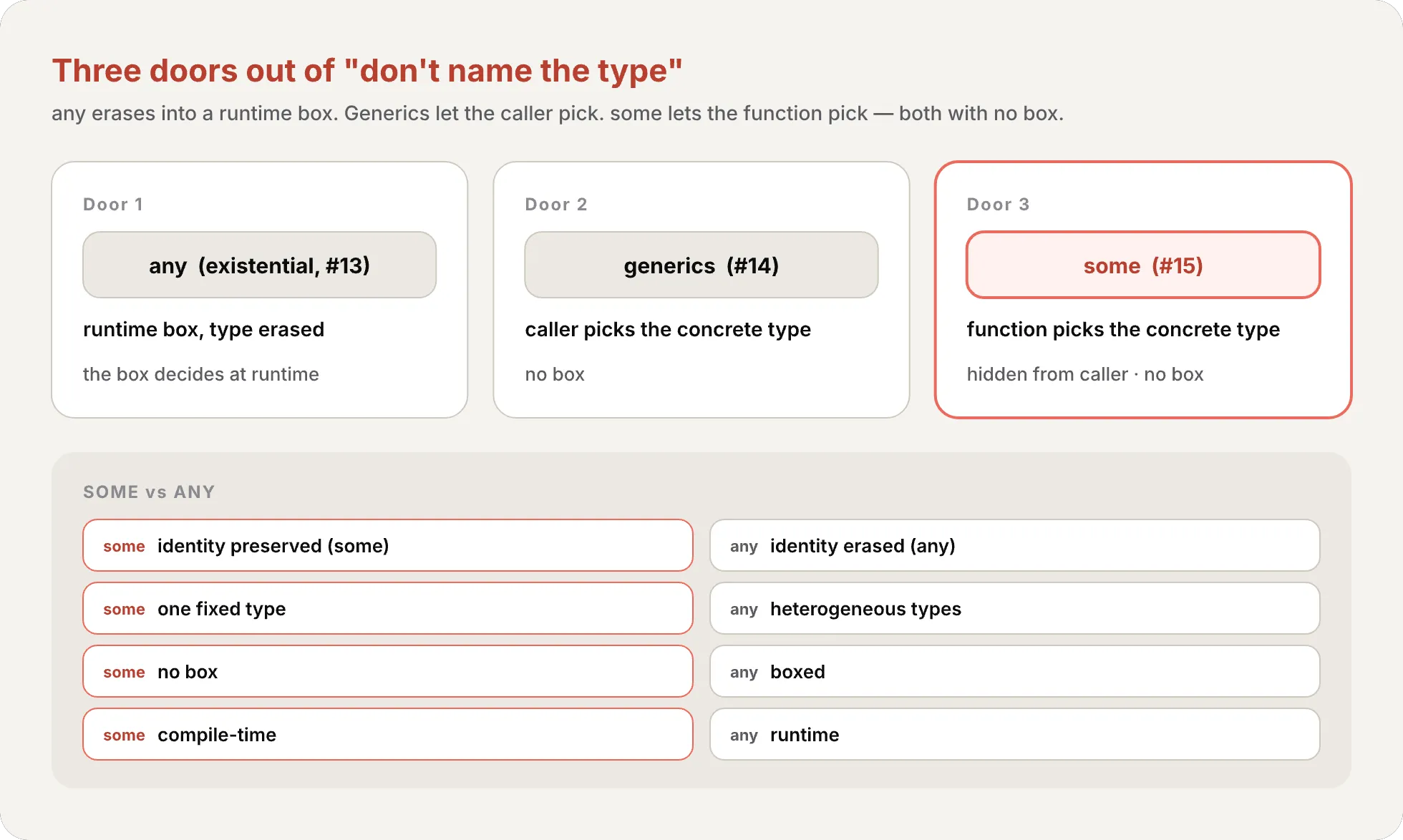
The third door out of 'I don't want to name the concrete type'. some hides one concrete type while keeping its identity — no box, compile-time. any erases the type into a runtime box. This is how you finally return a protocol that has an associatedtype.
At the end of #14 we counted three doors out of “I don’t want to name the concrete type.” any (from #13) boxes the value and pays at runtime. Generics (#14) let the caller name one concrete type, with no box. This article opens the third door: opaque types — the some keyword — where a function hides one specific concrete type while keeping it fully concrete. And it closes the loose end #14 left dangling: how do you return a protocol that has an associatedtype? some is the answer.
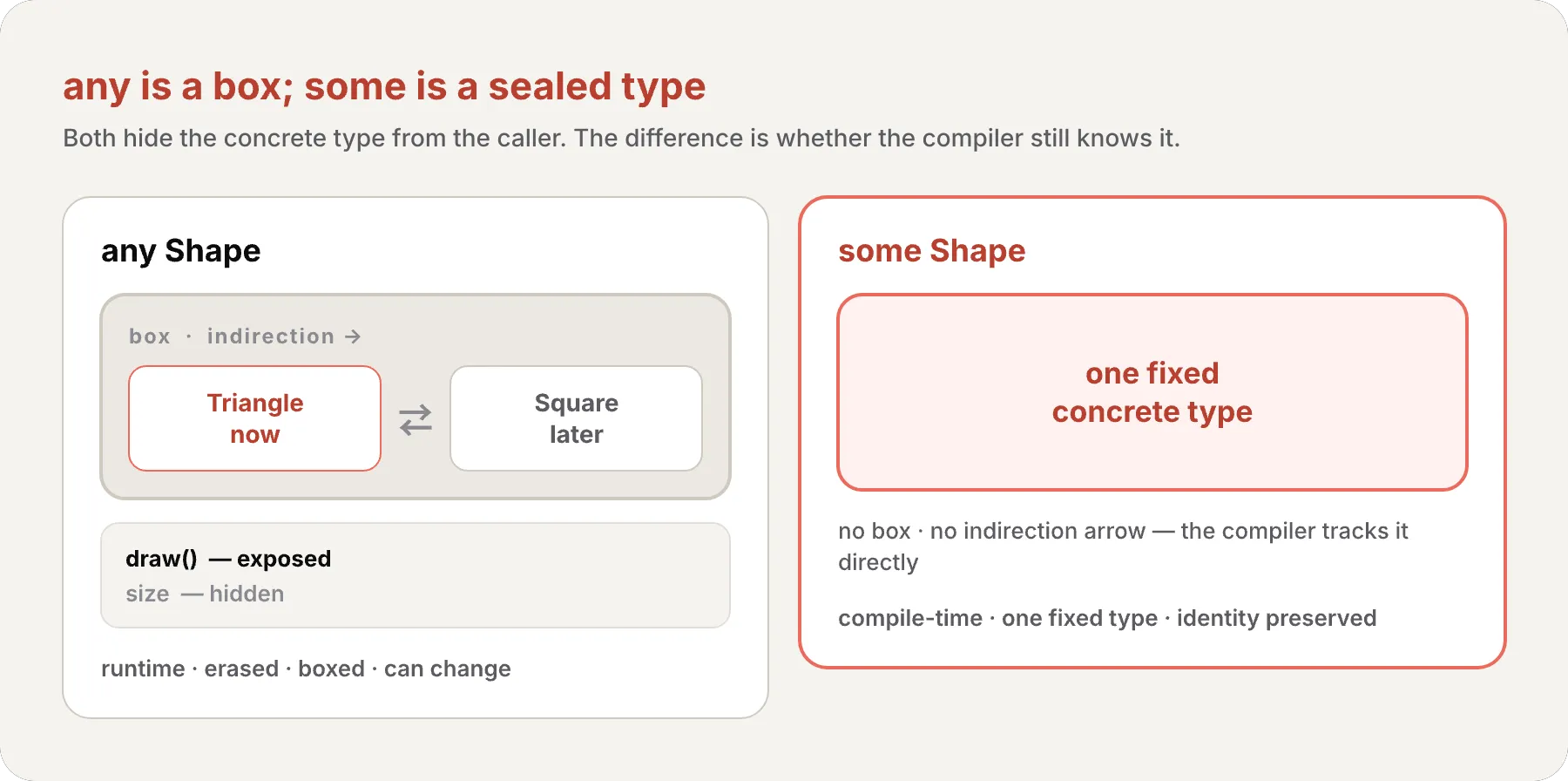
Swift gives you two ways to hide details about a value’s type, and this chapter is about telling them apart: opaque types (some) and boxed protocol types (any). Both hide the concrete type from the caller. The difference — the whole chapter — is whether the compiler still knows it.
some hides the type from you but not from the compiler: one concrete type, identity preserved, no box. any hides it from both: a runtime box that can hold a different concrete type from one moment to the next. Same goal, opposite mechanism.
The problem that opaque types solve
Picture a small module that draws ASCII-art shapes. The one thing every shape can do is draw() itself into a string — so that’s the Shape protocol, and Triangle is a first conformer (exactly the protocol from #13):
protocol Shape {    func draw() -> String}
struct Triangle: Shape {    var size: Int    func draw() -> String {        var result: [String] = []        for length in 1...size {            result.append(String(repeating: "*", count: length))        }        return result.joined(separator: "\n")    }}let smallTriangle = Triangle(size: 3)print(smallTriangle.draw())// *// **// ***
Now use the generics from #14 to build operations on shapes. A FlippedShape<T: Shape> wraps another shape and draws it upside down:
struct FlippedShape<T: Shape>: Shape { var shape: T func draw() -> String { let lines = shape.draw().split(separator: "\n") return lines.reversed().joined(separator: "\n") }}let flippedTriangle = FlippedShape(shape: smallTriangle)print(flippedTriangle.draw())// ***// **// *And a JoinedShape<T: Shape, U: Shape> stacks one shape on top of another:
struct JoinedShape<T: Shape, U: Shape>: Shape { var top: T var bottom: U func draw() -> String { return top.draw() + "\n" + bottom.draw() }}let joinedTriangles = JoinedShape(top: smallTriangle, bottom: flippedTriangle)print(joinedTriangles.draw())// *// **// ***// ***// **// *It works — but look at the type of joinedTriangles. It’s JoinedShape<Triangle, FlippedShape<Triangle>>. Every transformation you apply gets stamped into the return type, and that type spells out the entire build recipe: a join, of a triangle, with a flip, of a triangle. Stack a few more operations and the type name balloons into something unreadable — and, worse, public.
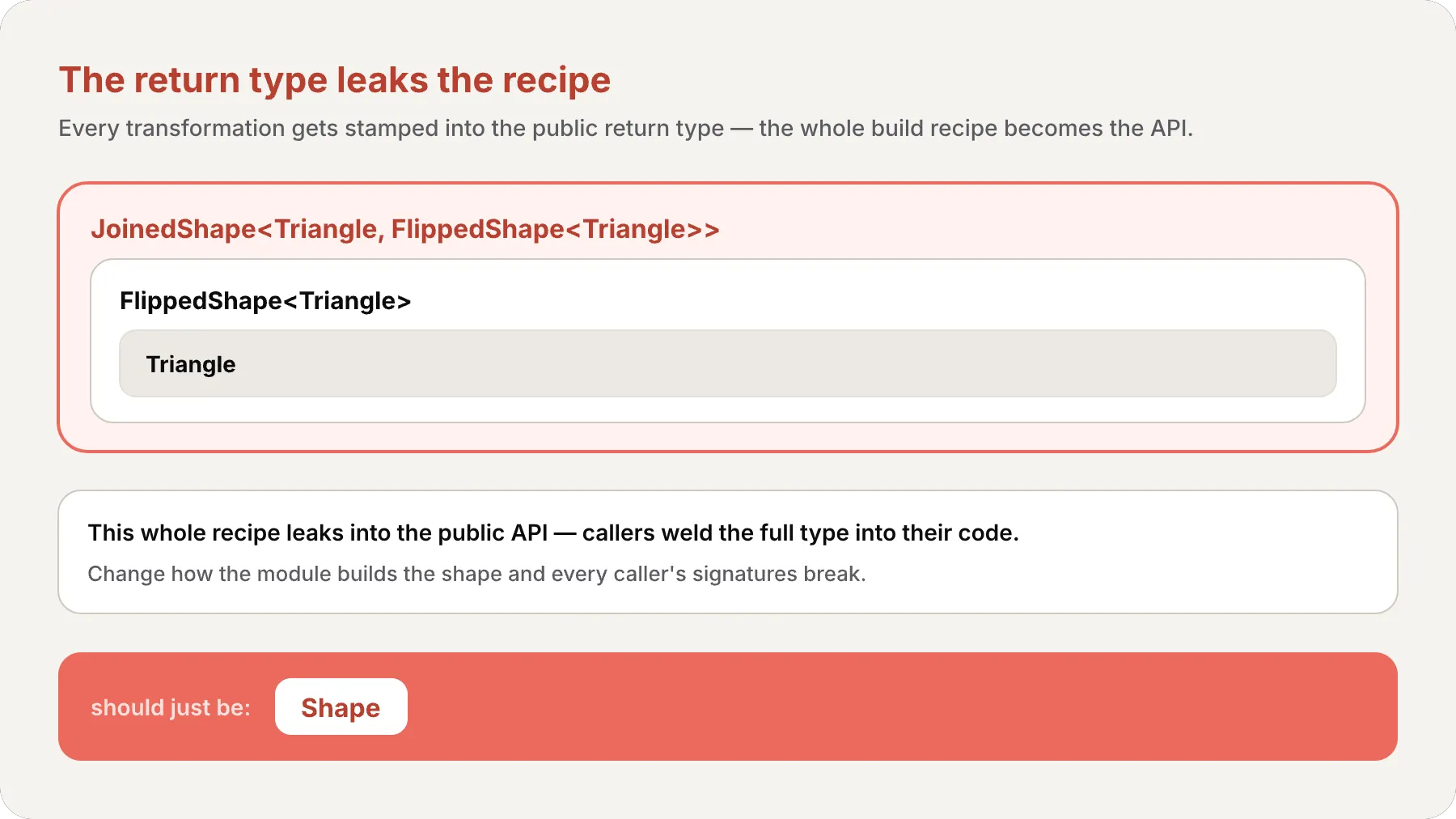
The module’s public interface should be “joining and flipping return another Shape.” The wrapper types shouldn’t be visible at all. That’s exactly what an opaque return type buys you.
Returning an opaque type
Add a Square, then write a makeTrapezoid() that builds a trapezoid out of triangles and a square — and returns some Shape:
struct Square: Shape {    var size: Int    func draw() -> String {        let line = String(repeating: "*", count: size)        let result = Array<String>(repeating: line, count: size)        return result.joined(separator: "\n")    }}
func makeTrapezoid() -> some Shape {    let top = Triangle(size: 2)    let middle = Square(size: 2)    let bottom = FlippedShape(shape: top)    let trapezoid = JoinedShape(        top: top,        bottom: JoinedShape(top: middle, bottom: bottom)    )    return trapezoid}let trapezoid = makeTrapezoid()print(trapezoid.draw())// *// **// **// **// **// *
The return type is some Shape — “some specific type that conforms to Shape, and I’m not telling you which.” Inside, the trapezoid is really a JoinedShape<Triangle, JoinedShape<Square, FlippedShape<Triangle>>>. The caller never sees that. They get a shape. Rewrite makeTrapezoid() to build the same picture a different way — different wrapper types entirely — and the public return type stays some Shape. The recipe is sealed inside.
An opaque type is the reverse of a generic. A generic lets the caller pick the concrete type; the function body must work for whatever comes in. some lets the function pick the concrete type; the caller must work with whatever comes out — without ever learning its name.
This mirror-image relationship is worth holding onto. With a generic max<T>(_:_:), the caller’s arguments decide T. With func makeTrapezoid() -> some Shape, the function’s body decides the underlying type, and the caller is the one written “in a general way” — it can only lean on what Shape guarantees.
You can combine some with generics, too. flip and join are generic because their inputs are generic, but they hide their FlippedShape/JoinedShape results behind some Shape:
func flip<T: Shape>(_ shape: T) -> some Shape {    return FlippedShape(shape: shape)}func join<T: Shape, U: Shape>(_ top: T, _ bottom: U) -> some Shape {    JoinedShape(top: top, bottom: bottom)}
let opaqueJoinedTriangles = join(smallTriangle, flip(smallTriangle))print(opaqueJoinedTriangles.draw())// *// **// ***// ***// **// *
opaqueJoinedTriangles draws exactly the same picture as the earlier joinedTriangles. The only difference is what the caller can see: joinedTriangles had the type JoinedShape<Triangle, FlippedShape<Triangle>> written across it; opaqueJoinedTriangles is just some Shape. The wrapper types are hidden.
The one rule: every return path, the same type
There’s a single rule that governs some, and it’s strict: all return paths of an opaque function must return the same underlying concrete type. The compiler knows the concrete type precisely — so you don’t get to pick a different one on different branches. Here’s the invalid version of flip that tries to special-case squares:
func invalidFlip<T: Shape>(_ shape: T) -> some Shape { if shape is Square { return shape // Error: Return types don't match. } return FlippedShape(shape: shape) // Error: Return types don't match.}Called with a Square this returns a Square; otherwise a FlippedShape. Two different underlying types from one opaque function — and that’s a compile error. The fix is to push the special case into FlippedShape.draw(), so the function always hands back a FlippedShape:
struct FlippedShape<T: Shape>: Shape { var shape: T func draw() -> String { if shape is Square { return shape.draw() } let lines = shape.draw().split(separator: "\n") return lines.reversed().joined(separator: "\n") }}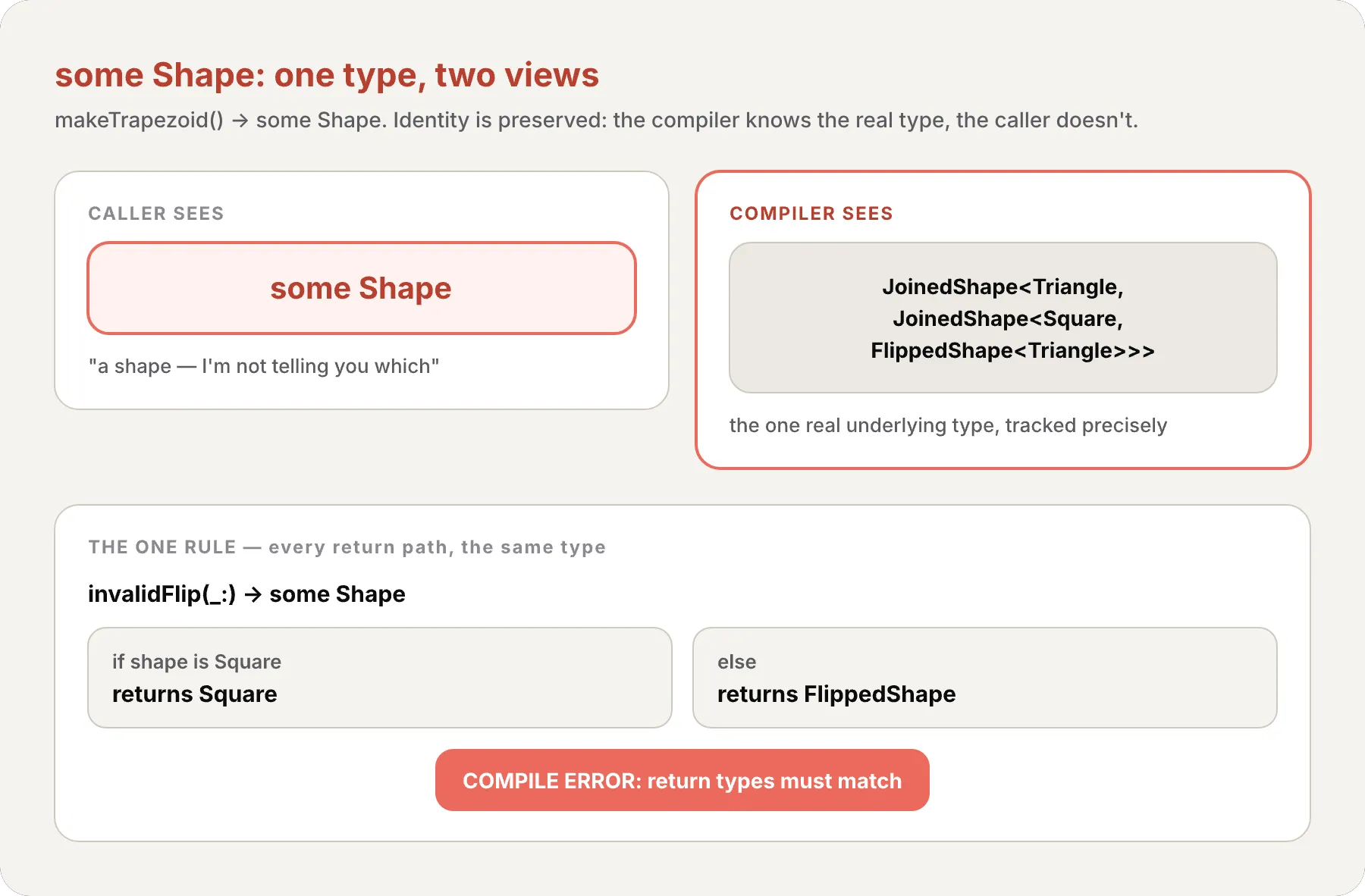
Boxed protocol types
Now the other door. A boxed protocol type is what you write with any — the existential from #13.
A VerticalShapes that holds an [any Shape] can mix concrete types freely — a triangle here, a square there:
struct VerticalShapes: Shape {    var shapes: [any Shape]    func draw() -> String {        return shapes.map { $0.draw() }.joined(separator: "\n\n")    }}
let largeTriangle = Triangle(size: 5)let largeSquare = Square(size: 5)let vertical = VerticalShapes(shapes: [largeTriangle, largeSquare])print(vertical.draw())
Each element of [any Shape] can be a different type, decided at runtime, as long as it conforms to Shape. To make that work, Swift wraps each value in a box — a level of indirection it adds when necessary, and that indirection has a performance cost. Inside VerticalShapes you can call draw() because Shape requires it; reaching for a triangle’s size is an error, because the box only exposes the protocol’s surface.
When you genuinely know what’s in the box, an as? cast (the downcast from #12/#13) gets you back to the concrete type:
if let downcastTriangle = vertical.shapes[0] as? Triangle { print(downcastTriangle.size)}// Prints "5".That cast is the tell. With any, peeling back to the concrete type is a runtime question — as? can fail and hands you an optional. With some, there’s no cast to write: the compiler knew the type all along.
some vs any: the differences that matter
Returning some Shape looks almost identical to returning any Shape. The split is whether type identity survives. An opaque type refers to one specific type the caller can’t see; a boxed protocol type can refer to any conforming type. Here’s the same flip written with a boxed return type — note it returns Shape boxed (any Shape), not some Shape:
func protoFlip<T: Shape>(_ shape: T) -> any Shape { return FlippedShape(shape: shape)}Because the contract is only “returns something Shape,” protoFlip is free to return different types on different branches — the exact thing invalidFlip was forbidden from doing:
func protoFlip<T: Shape>(_ shape: T) -> any Shape { if shape is Square { return shape } return FlippedShape(shape: shape)}That flexibility is real, but it costs you. Because the concrete type is erased, operations that depend on type information disappear. Two results of protoFlip can’t be compared with ==, even if you add == to Shape:
let protoFlippedTriangle = protoFlip(smallTriangle)let sameThing = protoFlip(smallTriangle)protoFlippedTriangle == sameThing // ErrorThe deeper reason: an == for Shape would need to know both sides are the same concrete type (Self), and that Self requirement is exactly what the box erases. The box also doesn’t statically conform to Shape: a bare any Shape can’t be composed where a static Shape conformance is required (say, as the T constraint inside another wrapper that stores var shape: T). Passing it to a generic <T: Shape> parameter, though, does work — Swift implicitly opens the existential, so protoFlip(protoFlip(smallTriangle)) actually compiles, with the inner box opened back into a concrete type for the outer call. Swap to some Shape and the identity-dependent operations (==, inferring an associatedtype) come back too, because the underlying type is preserved.
Here’s the contrast distilled:
some Shape (opaque) | any Shape (boxed) | |
|---|---|---|
| Type identity | preserved — one fixed concrete type | erased — concrete type hidden, even from the compiler |
| How many types | exactly one underlying type | heterogeneous — can hold different types over its lifetime |
| Box / indirection | no box, no indirection | boxed; a level of indirection with a runtime cost |
| Dispatch / timing | compile-time, static-dispatch friendly | runtime, dynamic |
| Position | reverse-generic (function decides, caller can’t see) | value-level (a box you store and pass around) |
Self / associatedtype returns | works as a return type | can’t, or needs care |
The trade is identity for flexibility. any will hold anything, change at any time, and box it for the privilege. some holds exactly one thing, forever, with no box — and in exchange keeps every operation that needs to know the real type.
The reason some exists: returning an associatedtype protocol
This is the loose end from #14. Recall the Container protocol with its associatedtype Item:
protocol Container { associatedtype Item var count: Int { get } subscript(i: Int) -> Item { get }}extension Array: Container { }Returning Container (i.e. any Container) is allowed, but it doesn’t get you what you want — because it has an associated type, the box erases Item down to Any, so you can’t recover the element type statically. And you can’t push it into a generic return position either, because there isn’t enough information outside the function body to infer the type:
// any Container is allowed, but Item is erased to Any — you can't recover the element type statically.func makeProtocolContainer<T>(item: T) -> Container {    return [item]}
// Error: Not enough information to infer C.func makeProtocolContainer<T, C: Container>(item: T) -> C {    return [item]}
some Container is the clean way out. It says “I return a container, but I won’t name its type” — and because identity is preserved, the compiler can still infer the associated Item:
func makeOpaqueContainer<T>(item: T) -> some Container { return [item]}let opaqueContainer = makeOpaqueContainer(item: 12)let twelve = opaqueContainer[0]print(type(of: twelve))// Prints "Int".The underlying container is [T]; with T == Int the Item resolves to Int, so twelve is an Int — the subscript’s return type flowed all the way through, even though the caller never saw [Int]. (type(of:) is Swift’s built-in that reports a value’s actual runtime type — here it confirms the compiler still tracks the concrete Int behind some Container.) This is the answer #14 promised: some is how you hand back a protocol that has an associatedtype. Associated types are the reason some exists.
![makeOpaqueContainer(item: 12) returns some Container; the underlying type is [Int] so Item is inferred as Int, and opaqueContainer[0] is Int — the subscript's return type flows all the way to the caller; contrasted with any Container, where the box can't know Item and won't compile](/_astro/associatedtype-flow.UOY3ful5_ZbQftT.webp)
Opaque parameter types
There’s one more place some shows up — and it means something slightly different there. You can write some on a parameter type, where it’s shorthand sugar for a generic, not an opaque return. These two functions are equivalent:
func drawTwiceGeneric<SomeShape: Shape>(_ shape: SomeShape) -> String {    let drawn = shape.draw()    return drawn + "\n" + drawn}
func drawTwiceSome(_ shape: some Shape) -> String {    let drawn = shape.draw()    return drawn + "\n" + drawn}
some Shape in parameter position creates an unnamed generic type parameter constrained to Shape — exactly what <SomeShape: Shape> does, just without giving the type a name you could refer to elsewhere. Write some on more than one parameter and each is an independent generic:
func combine(shape s1: some Shape, with s2: some Shape) -> String {    return s1.draw() + "\n" + s2.draw()}
combine(shape: smallTriangle, with: trapezoid)
s1 and s2 must each conform to Shape, but they needn’t be the same type — so a triangle and a trapezoid are both fine. This lightweight syntax can’t carry a generic where clause or same-type (==) constraints; reach for the named <T: Shape> form when you need those.
Under the hood: some is compile-time, any is runtime
Strip away the syntax and the whole chapter reduces to when the concrete type is known.
some= compile time. One concrete type, fixed for good, identity preserved. No box, no indirection. The compiler knows the real type, so it can specialize and dispatch statically — and keep operations (like==, or inferring anassociatedtype) that need the real type. The caller is kept in the dark; the compiler is not.any= runtime. A box, an existential. The concrete type is erased — unknown until runtime, free to change as you store new values. The flexibility (heterogeneous collections, branch-dependent returns) is paid for with a level of indirection and the loss of type-specific operations.
That’s the same axis #13 and #14 have been circling. any boxes and pays at runtime. Generics let the caller name the type with no box. some lets the function name the type with no box. Three doors — and now you’ve walked through all of them.
Recap
- The problem — generic wrappers like
FlippedShape<Triangle>andJoinedShape<Triangle, FlippedShape<Triangle>>leak the build recipe into the public return type, making the API brittle - Opaque type —
func makeTrapezoid() -> some Shapereturns one specific concrete type the caller can’t see; the reverse of a generic (function picks the type, not the caller) - The one rule — every return path must produce the same underlying type;
invalidFlipreturningSquareon one branch andFlippedShapeon another is a compile error - Identity preserved — with
some, the compiler knows the concrete type; it’s hidden from the caller, not erased - Boxed protocol type —
any Shapeis an existential box that can hold different conforming types over its lifetime, at the cost of runtime indirection - some vs any — identity preserved vs erased; one type vs heterogeneous; no box vs boxed; compile-time vs runtime; reverse-generic position vs value-level
- Returning an associatedtype protocol — you can’t return
any Container(the box can’t knowItem), butsome Containerworks and theItemis still inferred — the answer to #14’s open question - Opaque parameter types —
func f(_ p: some Shape)is sugar for<T: Shape>(caller picks), not an opaque return; contrastfunc f(_ p: any Shape)(runtime box) - Under the hood —
some= compile-time, one type, no box, static-dispatch friendly;any= runtime existential box, dynamic
Challenges
Open a playground and try each one before opening the solution.
Challenge 1: Why won’t it compile?
This function is meant to return one hidden shape type, but it doesn’t build. Explain why, and describe the fix.
protocol Shape { func draw() -> String }struct Triangle: Shape { var size: Int; func draw() -> String { "△" } }struct Square: Shape { var size: Int; func draw() -> String { "□" } }
func pick(big: Bool) -> some Shape {    if big {        return Square(size: 10)    } else {        return Triangle(size: 1)    }}
Show solution
It fails because the two return paths produce different underlying types — Square on one branch, Triangle on the other. An opaque some Shape function must return a single concrete type from every path; the compiler tracks that one type precisely and won’t accept two. (error: function declares an opaque return type 'some Shape', but the return statements in its body do not have matching underlying types.)
The fix depends on intent. If callers genuinely need either type chosen at runtime, you don’t want an opaque type at all — return the boxed any Shape, which is allowed to hold different concrete types:
func pick(big: Bool) -> any Shape { return big ? Square(size: 10) : Triangle(size: 1)}If instead you want one fixed hidden type, make every path return the same type. The branch-on-type belongs inside one concrete type, not across the return statements — the same move that fixed invalidFlip.
Challenge 2: Read the identity
Without running it, what does this print — and why does it work with some but would fail with any?
protocol Container {    associatedtype Item    var count: Int { get }    subscript(i: Int) -> Item { get }}extension Array: Container {}
func wrap<T>(_ value: T) -> some Container {    return [value, value, value]}
let c = wrap("hi")print(c.count)print(type(of: c[0]))
Show solution
3Stringwrap("hi") builds ["hi", "hi", "hi"], so count is 3, and each element is a String. The interesting part is why this compiles at all. Container has an associatedtype Item. Returning -> Container (i.e. -> any Container) is allowed, but the box erases Item to Any, so c[0] would come back as Any and you’d lose the static element type. some Container instead preserves type identity: the underlying type is [String], so the compiler infers Item == String, and c[0] is statically a String. That’s why type(of: c[0]) prints String and not the erased Any. Opaque types are the only way to return an associated-type protocol while keeping its Item known.
Challenge 3: some, any, or generic?
For each parameter declaration below, say whether it means the same as a generic <T: Shape>, and whether it boxes the value.
func a(_ p: some Shape) { print(p.draw()) }func b(_ p: any Shape) { print(p.draw()) }func c<T: Shape>(_ p: T) { print(p.draw()) }Show solution
a and c are equivalent. some Shape in parameter position is just shorthand sugar for an unnamed generic type parameter constrained to Shape — exactly what <T: Shape> declares, only without a name you could reuse elsewhere. The caller picks one concrete type, the compiler knows it statically, and there’s no box.
b is different. any Shape is a boxed protocol type — an existential. The caller can pass any conformer, the concrete type is erased to runtime, and the value carries a box with its level of indirection. You’d reach for b only when you genuinely need to accept differently-typed shapes through one parameter (e.g. iterating an [any Shape]); otherwise a/c are cheaper.
The keyword some flips meaning by position: opaque (function picks) on a return type, generic sugar (caller picks) on a parameter.
What’s next
That closes the protocols-and-abstraction arc: a protocol is a contract (#13), generics let the caller abstract over types (#14), and opaque types let a function abstract over its own return type (#15). You now have all three doors — any, generic <T>, and some — and, just as importantly, the judgement for which to reach for: box only when you truly need heterogeneity, otherwise keep the type and lose the box.
See you next week.
any, <T>, some — three ways to say “I’d rather not name the type,” each making a different promise. any: “it could be anything, and I’ll pay the box.” Generic: “you name it.” some: “I know it, you don’t, and there’s no box.” Knowing the difference is knowing where Swift spends — and saves — at runtime.
References
Related
-
- swift
- swift-zero-expert
- swift-fundamentals
Swift from Zero to Expert #14: Generics
One swapTwoValues, one Stack<Element>, one findIndex — written once, working for every type. Generics let the caller pick the concrete type, the compiler specialize the code, and the box from #13 disappear. Array, Dictionary, Optional, and Result were generic all along.
-
- swift
- swift-zero-expert
- swift-fundamentals
Swift from Zero to Expert #13: Protocols
A protocol is a contract, not a class. It says what a type must do without saying what it is — and that single idea powers delegation, synthesized Equatable, existentials, and the protocol extensions that make Swift idiomatic.
-
- swift
- swift-zero-expert
- swift-fundamentals
Swift from Zero to Expert #12: Error Handling
throw, try, do/catch, defer, rethrows, Result, and Swift 6 typed throws. An error isn't a magic exception — it's just a value of a type that conforms to Error, routed through your call stack as cheaply as a return.