

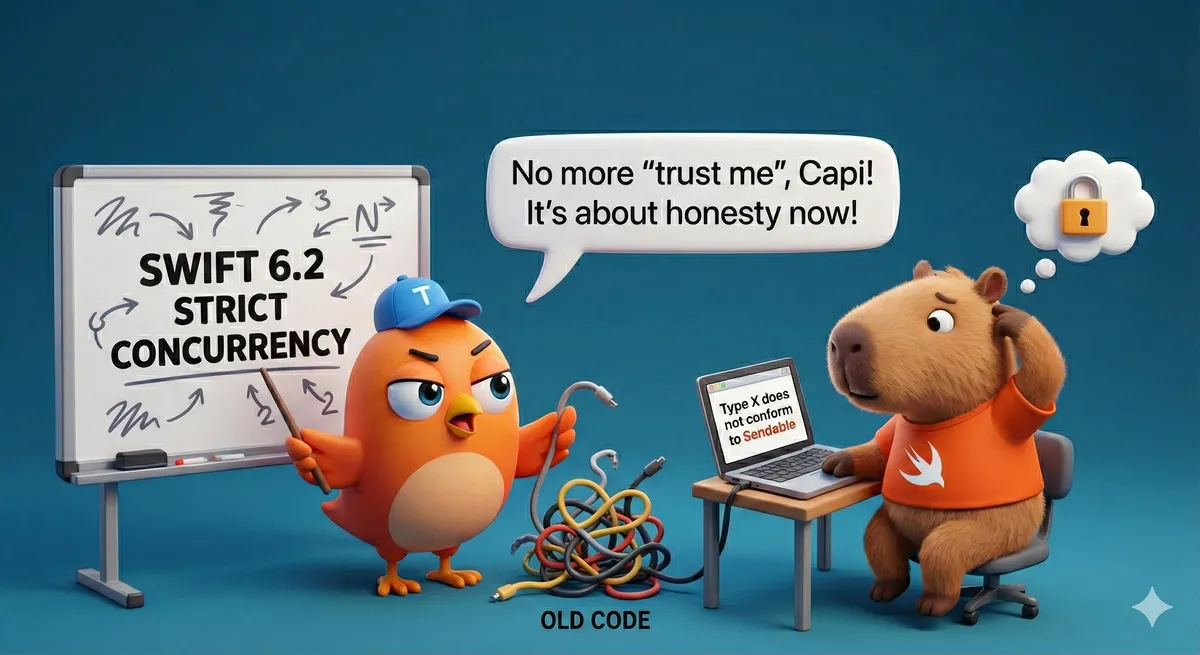
Swift Refresh 2025 – Day 1: Concurrency in Swift 6.2 (Without Unnecessary Pain)
An honest recap of Swift 6.2 strict concurrency: actors, @MainActor, Sendable, and how to migrate without suffering in real-world projects.
Introduction
Swift 6 did not come to make our lives harder.
It came to tell us the truth.
Day 1 of the Swift Refresh Workshop 2025 was not a firehose of new APIs or a list of changes to memorize.
It was something much more important: a mindset shift.
Swift 6.2 redefines how we write concurrent code, but more importantly, how we think about safety, ownership, and design.
If you felt “this used to work before”, you’re not alone.
The difference is that it worked… until it didn’t.
1. The problem Swift 6 wants to eliminate
For years, on iOS we lived with an uncomfortable reality:
- Concurrent code that looked “apparently” correct
- Intermittent bugs
- Crashes that were impossible to reproduce
- Silent race conditions
Classic example:
var counter = 0

DispatchQueue.global().async {
    counter += 1
}
This has always been incorrect. It’s a textbook data race.
Swift 5 allowed it without complaining. Swift 6, in strict concurrency mode, flags it (and may refuse to compile it depending on your settings).
👉 The novelty is not “more concurrency”.
The novelty is the compiler’s honesty.
2. Strict Concurrency: what actually changes
Swift 6.2 introduces what Apple calls Strict Concurrency.
Translated to human:
“If I can’t guarantee this access is safe, I’ll tell you.
If you enable strict mode, I won’t compile.”
In practice, you get a progressive migration path:
- You can start with warnings for legacy code.
- You can tighten things up until certain unsafe patterns become compile-time errors.
Now, every piece of data has to fit (at least) one of these ideas:
- Be immutable
- Be isolated by an actor
- Live in a clear context (
@MainActoror another global actor) - Be explicitly
Sendableif it crosses concurrency boundaries
If not… error (or at least a very insistent warning).
It’s not punishment.
It’s prevention.
3. @MainActor: not a thread, a contract
@MainActor is one of the most misunderstood (and most important) concepts in Swift 6.
@MainActor
final class ViewModel {
    var title: String = ""
}
This does not just mean “this runs on the main thread”.
It means something much more useful:
“This state can only be touched from the main context.”
Swift now:
- Protects your UI
- Protects your ViewModels
- Warns you if you access this state from another context without hopping to the main actor (
await MainActor.run { ... })
Before, it trusted you.
Now, it protects you from yourself.
4. Actors: the safe box for your data
An actor is the modern, safe way to manage shared mutable state.
Simple mental model:
An actor is a room where only one person can enter at a time.
actor Counter {
    private var value = 0

    func increment() {
        value += 1
    }

    func getValue() -> Int {
        value
    }
}
No locks.
No manual queues.
No black magic.
👉 If some data is mutable and shared, it probably belongs in an actor.
5. Global actors: architecture, not just concurrency
Sometimes you need something like @MainActor, but scoped to your domain:
- Persistence
- Networking
- SwiftData
- Caching
That’s where global actors come in.
Typical definition:
@globalActor
struct DatabaseActor {
    static let shared = DatabaseActorImpl()
}

actor DatabaseActorImpl {
    // Database state and operations
}
And then:
@DatabaseActor
func saveUser() {
    // Safe implementation around DatabaseActorImpl
}
This doesn’t just give you concurrency safety.
It gives you structure:
- Forces you to decide where logic lives.
- Makes it obvious from where critical resources are accessed.
6. Approachable Concurrency: the human side of Swift 6
Swift 6 is strict, and Apple knows it.
The idea of Approachable Concurrency doesn’t change the rules, but it does change the experience:
- Better compiler messages
- A progressive migration path from Swift 5.x
- Less frustration in large codebases
- A model that is teachable (and explainable to your team)
It’s Swift saying:
“I won’t let you get away with mistakes…
but I’ll explain why.”
7. The recurring villain: Sendable
Many Day 1 errors share the same message:
Type X does not conform to Sendable
Real translation:
“I can’t guarantee this data will be safe when it crosses concurrency boundaries.”
Important details in 2025:
- Simple value types (structs, enums without tricks) are often
Sendableautomatically. - The pain shows up with:
- Classes holding shared mutable state
- Closures capturing
self - Older APIs without concurrency annotations
And no, slapping Sendable on something “to silence the error” is not the solution.
Swift 6 doesn’t want you to lie to it.
It wants you to design your data model better.
8. Legacy APIs: when the past catches up
Typical example:
NotificationCenter.default.addObserver(
    forName: .someEvent,
    object: nil,
    queue: nil
) { [weak self] _ in
    self?.value += 1
}
Why does this start to hurt now?
- There is no thread guarantee in that legacy API
- The closure captures
self selfmay not be concurrency-safe
Before: “trust me, it’s fine”.
Now: “prove it”.
Swift forces you to decide:
- Should this state live inside an
actor? - Should part of this logic move to
@MainActor? - Should I redesign this notification API to make it safe?
9. Migrating to Swift 6 without suffering
The lesson from Day 1 is clear:
- Swift 6 doesn’t “break” your code for sport
- It exposes incorrect assumptions that were already there
- It pushes you to clean up concurrency technical debt
The right mental order:
- Who owns this piece of data?
- From where is it accessed?
- Does it need to live inside an
actor? - Should it be protected by
@MainActoror another global actor? - Will it cross concurrency boundaries? (threads, tasks, queues)
Answering these questions honestly avoids 90% of migration errors.
10. Clean Architecture + Swift 6 = perfect match
Swift 6 naturally favors:
- Clear layers (UI, domain, data)
- Explicit dependencies
- ViewModels protected with
@MainActor - Use cases and repositories isolated (often with dedicated actors)
- A domain that does not depend on infrastructure details
In 2025, with SwiftData, macros, and more mature tooling, this is no longer just an academic “best practice”.
It’s literally the path of least resistance enforced by the compiler.
Conclusion
Swift 6 is not making your life harder. It forces you to write the code you should have written all along.
It costs a bit more effort up front, but prevents concurrency bugs, impossible-to-reproduce crashes, and silent race conditions.
For real-world projects in 2025, that is worth far more than saving two lines of code.
Notes taken during the Swift Developer Workshop 2025 (Apple Coding Academy) and reinterpreted from a practical, real-world perspective.